 Genzee
Understanding Your Payslip: Every Line Explained
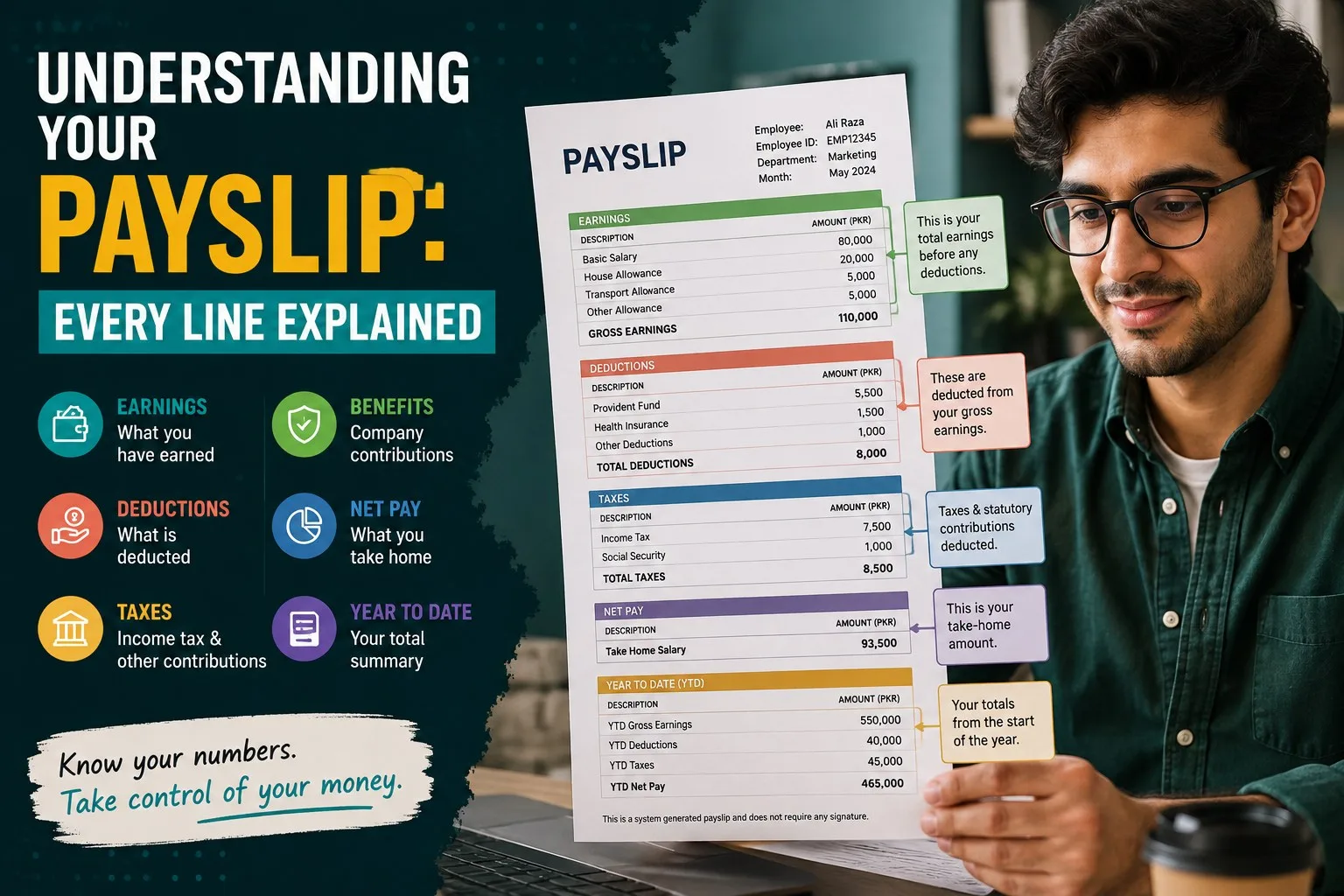
Most people check exactly one number on their payslip — the one that lands in the bank — and file the rest under "mysterious". But those few lines encode your entire financial relationship with your employer: how your pay is structured, what's being saved for your future, what the government takes, and whether any of it is wrong. Payroll errors are more common than anyone admits, and the only person who will catch one on your slip is you. Here's a line-by-line tour of a typical Pakistani payslip.
The earnings side
Basic salary
The foundation stone. Many other figures are defined as percentages of basic — provident fund contributions, gratuity accrual, the exempt medical allowance cap, often overtime rates. A package "structured" with low basic and high allowances isn't automatically in your favour: it shrinks fund contributions and gratuity too. Understand the split before celebrating a restructure.
House rent allowance (HRA)
Commonly around 40–45% of basic in Pakistani salary structures. It's taxable for most salaried employees — its main significance is historical convention and its role in the package's arithmetic.
Medical allowance
The interesting one: where the employer doesn't provide medical facilities, medical allowance up to 10% of basic salary is tax-exempt. Check that your slip shows it as a separate line — folded into basic, the exemption can be lost. More in our guide to deductions and credits.
Utilities, conveyance, and other allowances
Generally taxable cash. Fuel cards and company-maintained cars have their own valuation rules — if you have one, your taxable figure may differ from the cash you see.
Bonus / overtime / arrears
Taxable in the month received, which can make that month's tax deduction jump — payroll recalculates your projected annual tax including the bonus. The spike is normal; the annual total is what matters.
The deductions side
Income tax (withholding under section 149)
Your employer estimates your annual taxable salary, computes tax under the current slabs, divides by twelve, and remits it against your CNIC. Verify it in one minute: put your monthly gross into our salary tax calculator — the FY 2026-27 slabs are built in — and compare. A small difference usually means an exemption or a mid-year raise re-averaging; a big one means a conversation with payroll.
Provident fund (PF)
Typically you contribute a percentage of basic (often 8.33–10%) and the employer matches it. Your contribution is your own money saved; the match is extra compensation many people forget they earn. Both grow tax-favourably in a recognised fund. If you can contribute more voluntarily, the compounding maths argues loudly for it.
EOBI
The Employees' Old-Age Benefits Institution — a small statutory contribution (the employer pays the larger share) building your entitlement to the state old-age pension. Tiny line, but confirm it exists: EOBI registration is a legal right, and pension entitlement needs contribution history.
Loan installments / advances / other
Any salary advance or company-loan repayment appears here. Check the balance math occasionally — payroll systems have been known to keep deducting a completed loan.
The bottom line: net pay
A worked example: gross PKR 150,000 (basic 90,000 + HRA 40,000 + medical 9,000 + conveyance 11,000). Income tax: annual taxable ≈ 1,692,000 (medical exempt) → about 60,120/year → 5,010/month. PF at 10% of basic: 9,000. EOBI: a few hundred. Net lands around PKR 135,700. If your own slip's tax line looks far from the calculator's answer for your numbers, ask payroll to walk you through their projection — politely; it's usually a raise, a bonus or an exemption you forgot.
Five checks worth doing every few months
- Recompute the tax line with the calculator.
- Confirm PF shows both your contribution and the employer match, and get the fund's annual statement.
- Verify medical allowance appears as its own line.
- Glance at year-to-date tax versus your annual projection — big gaps surface early here.
- Keep every slip (or PDF). They're your evidence for filing your return, loan applications and disputes.
A payslip is a contract performed monthly. Ten minutes of understanding it once — and one minute of checking it thereafter — is all the financial vigilance most employees ever need.
Payslip questions worth asking HR (politely)
A few structural questions can be worth real money, and payroll teams answer them routinely. "Can my package be restructured?" — the split between basic and allowances changes your provident fund accrual, gratuity base and the medical-allowance exemption; within company policy there is sometimes room to structure tax-efficiently, especially at annual review. "Is the provident fund recognised, and what are my vesting rules?" — recognised funds carry the tax advantages, and vesting rules decide how much employer match you keep if you leave next year; both belong in your job-change arithmetic. "Where does my gratuity stand?" — gratuity typically accrues a month's basic per service year; knowing the current figure turns a resignation decision from guesswork into numbers. "Why did this month's tax jump?" — bonuses and raises trigger re-averaging of the annual projection; asking for the projection sheet shows you exactly how the monthly figure was derived, which you can verify against the salary tax calculator. Keep the answers with your payslip archive: between them, your slips, fund statements and the deductions guide, you hold a complete, verifiable picture of your compensation — which is precisely the position from which raises are best negotiated.