 Genzee
Gen Z Strengths and Weaknesses: What the Research Actually Shows
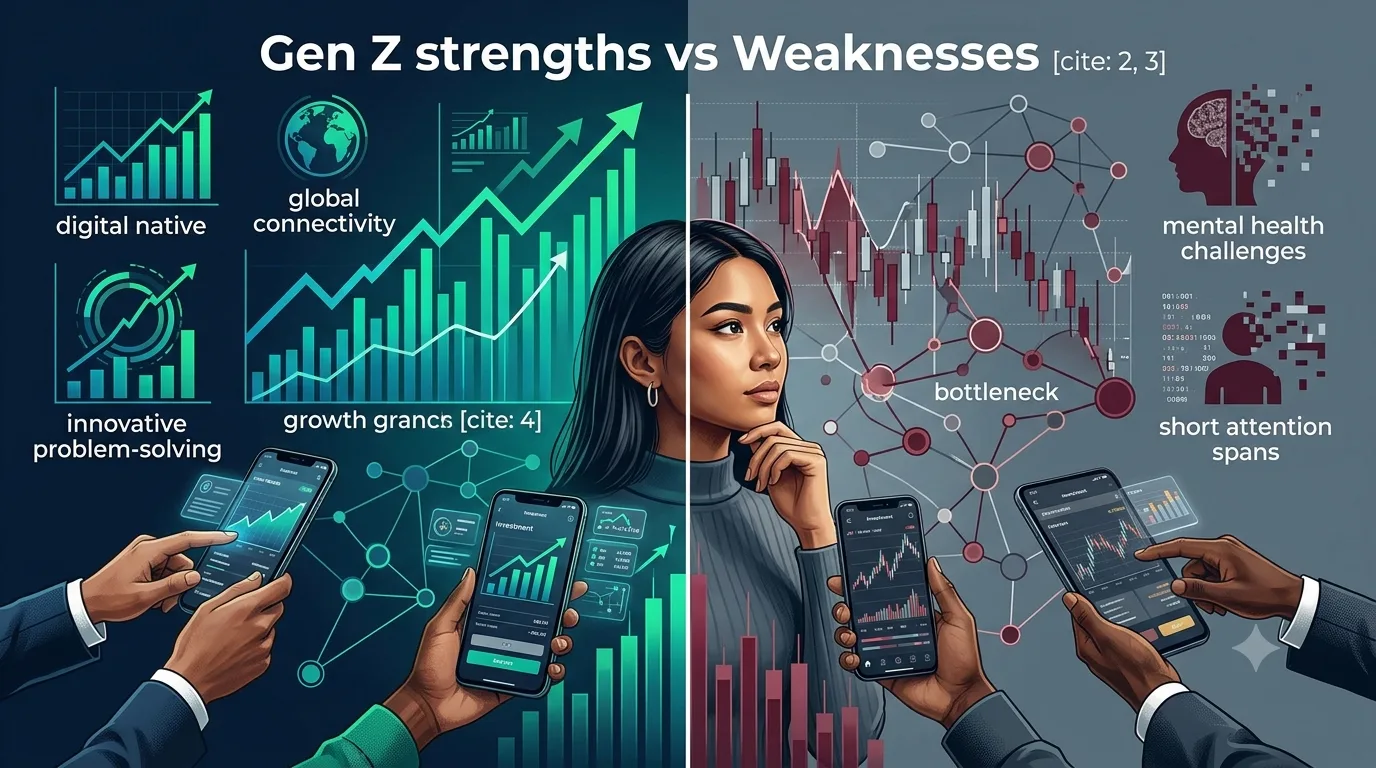
Almost everything written about Gen Z's personality is opinion dressed as analysis. This piece sticks to what large surveys and studies actually measure — and is explicit about where the evidence is thin or contested.
One caveat worth stating up front: every finding below is a population-level average across a cohort of roughly two billion people worldwide. None of it predicts anything about an individual.
What the evidence reasonably supports
Higher formal education, worse early-career returns
Gen Z has the highest rates of secondary and tertiary enrolment of any cohort in history. At the same time, graduate underemployment — working in roles that do not require the degree held — has risen in most OECD countries relative to when Millennials entered the workforce. Both things are true simultaneously, and the combination explains a lot of the frustration this cohort reports about education-to-work transitions.
Genuinely different technology fluency, but not universal
The "digital native" claim needs qualifying. Gen Z is unambiguously more fluent with mobile interfaces, short-form video and social platforms than earlier cohorts were at the same age. But multiple workplace studies have found this fluency does not automatically transfer to desktop productivity software, file systems or troubleshooting — skills earlier cohorts acquired precisely because the technology was harder to use. Growing up with technology that works well is not the same as growing up understanding it.
Financial caution, driven by circumstance
Surveys consistently find Gen Z reporting higher financial anxiety and more conservative attitudes toward debt than Millennials did at the same age. The straightforward explanation is that they watched the 2008 crisis affect their parents and older siblings, and are entering housing markets at historically poor price-to-income ratios. Deloitte's annual Gen Z and Millennial survey has found cost of living ranking as the top concern for this cohort for several consecutive years.
Higher reported mental health difficulty
Self-reported anxiety and depression are measurably higher in this cohort than in previous ones at comparable ages, across many countries. What the data does not settle is how much of that is a real increase in underlying prevalence versus a genuine increase in willingness to report and seek diagnosis — reduced stigma would produce a similar-looking rise. Researchers disagree about the split, and anyone who tells you it is definitively one or the other is overstating the evidence.
Where the popular narrative is weakest
"Gen Z doesn't want to work"
Labour force participation data does not support this. What surveys do find is different expectations about flexibility, remote arrangements and employer values — and a lower tolerance for staying in an unsatisfying job. That is a change in the terms of employment being negotiated, not an unwillingness to be employed. Nearly identical complaints were made about Millennials in 2010 and Gen X in 1993.
"Gen Z has an eight-second attention span"
This claim traces back to a widely-circulated statistic with no identifiable original study behind it, frequently attributed to a Microsoft report that did not actually make the claim. It is not supported by attention research. Treat it as a myth.
"Gen Z is uniquely entitled"
The entitlement charge has been levelled at every young cohort in living memory and consistently fails to hold up when the same measures are applied to earlier generations at the same age. It is close to a permanent feature of how older cohorts perceive younger ones rather than a finding about any specific one.
How to read generational research at all
Three questions worth asking about any claim you encounter:
- Is it comparing cohorts at the same age? Comparing 22-year-olds today with 45-year-olds today measures age, not generation.
- Is it based on a survey with a stated sample, or on a consultant's assertion? A great deal of generational content is the latter.
- Does the claim have a plausible mechanism? "Grew up in a weaker entry-level job market, so accumulated less wealth by 25" is a mechanism. "Is inherently more entitled" is not.
Related reading
For the definitions themselves, see what Gen Z means and Gen Z birth years. For a cohort-by-cohort comparison, see Gen Z vs Gen Alpha vs Millennials vs Boomers. To check your own cohort, use the generation calculator.