 Genzee
The Power of Compound Interest: Why Starting Early Matters
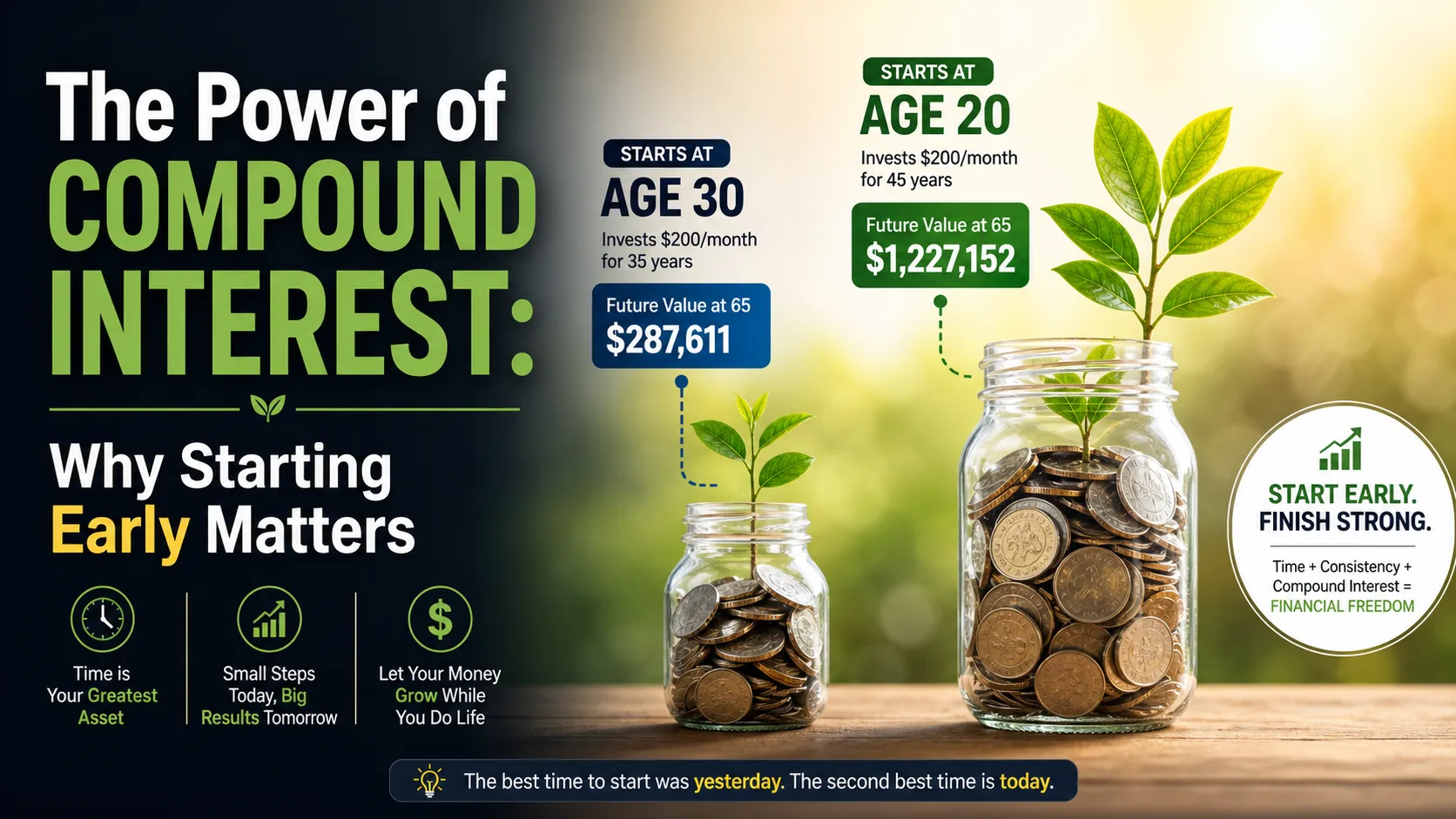
There is one financial force that quietly outperforms every clever trick, hot tip and market prediction: time. Compound interest — earning returns on your returns — is slow at first, almost boring, and then suddenly it isn't. This article shows the mechanics with real numbers, and why the single most valuable financial decision most people ever make is simply starting early. Test every table below yourself in the compound interest calculator.
Simple vs compound: the fork in the road
Put PKR 100,000 somewhere earning 10% a year. With simple interest, you earn a flat 10,000 every year — after 30 years you have 400,000. With compound interest, each year's interest joins the principal and earns its own interest:
Same deposit, same rate — but compounding produces more than four times the result. The gap between the two curves is almost invisible for the first few years, which is exactly why people underestimate it.
The snowball, decade by decade
PKR 100,000 at 10% compounded yearly:
Read the right-hand column: each decade earns more than all previous decades combined. The fourth decade alone adds 2.78 million — 17 times what the first decade added. Nothing changed except time.
Ayesha vs Bilal: the cost of waiting ten years
Two friends, same salary, same discipline, same 10% return. Ayesha invests PKR 100,000 at age 25 and never adds another rupee. Bilal waits until 35, then invests double — PKR 200,000. At age 60:
- Ayesha: 100,000 × (1.10)³⁵ = PKR 2,810,244
- Bilal: 200,000 × (1.10)²⁵ = PKR 2,166,940
Ayesha invested half as much and finished about 30% richer. Bilal's extra 100,000 could not buy back the ten years of compounding he skipped. That is the entire argument for starting early, in two lines of arithmetic.
The Rule of 72
For quick mental maths, divide 72 by the annual return to get the approximate doubling time:
- At 6%: doubles every ~12 years
- At 10%: doubles every ~7.2 years
- At 12%: doubles every ~6 years
Over a 36-year working life, money at 12% doubles roughly six times — a 64× multiple. The rule also works grimly in reverse: at 25% inflation, prices double in under three years, which is why money idle in a current account quietly shrinks.
Compounding works against you, too
Credit card balances and late-payment penalties compound in the wrong direction. A card charging 3% a month compounds to about 42.6% a year — an unpaid PKR 100,000 balance becomes 142,576 in twelve months without a single new purchase. The same force that builds savings demolishes debt-carriers; pay compounding debt first, always. (Loan EMIs are tamer because each payment cuts the balance — see how EMIs work.)
Making it practical
- Start with any amount. The tables scale: 10,000 follows the same curve as 100,000. The habit matters more than the amount.
- Prefer higher compounding frequency at the same rate — monthly beats yearly slightly — but never let frequency distract from the rate itself.
- Beat inflation or you are standing still: the real return is your rate minus inflation. A 15% return during 25% inflation is a 10% loss of purchasing power.
- Reinvest the profit. Compounding only happens if the interest stays invested. Withdrawing profit each year converts your compound curve back into a flat simple-interest line.
- Leave it alone. Every early withdrawal amputates the fattest, final years of the curve — the ones carrying most of the gains.
Open the calculator, enter what you could set aside this month, and look at the 20-year line. That number — not this article — is what usually convinces people.
Putting compounding to work this month
Theory converts to money through boring mechanics, so here is the checklist. One: pick a vehicle where returns actually reinvest — a savings account that credits profit monthly, an income or money-market fund that compounds units, or certificates whose profit you roll over rather than withdraw. Ask the specific question: "is the profit paid out or reinvested?" — payout products quietly convert your compound curve into a flat line. Two: automate a fixed transfer on salary day, because compounding needs feeding as well as time; the 50/30/20 rule supplies the number and the savings goal calculator shows the payoff schedule. Three: defend the balance from yourself — every withdrawal amputates all of that money's future doublings, which is the real price tag the ATM never shows. Four: mind the after-tax, after-inflation rate: withholding tax on profit and double-digit inflation both shave the exponent, so compare instruments on net real return, not the poster rate. And five: re-run the numbers yearly. A 1% improvement in rate feels trivial and compounds into years of extra growth over a working life — the calculator makes the comparison a thirty-second habit. Time does the heavy lifting; your job is merely to keep the machine loaded and switched on.