 Genzee
Tax Deductions and Credits in Pakistan: What Salaried People Can Claim
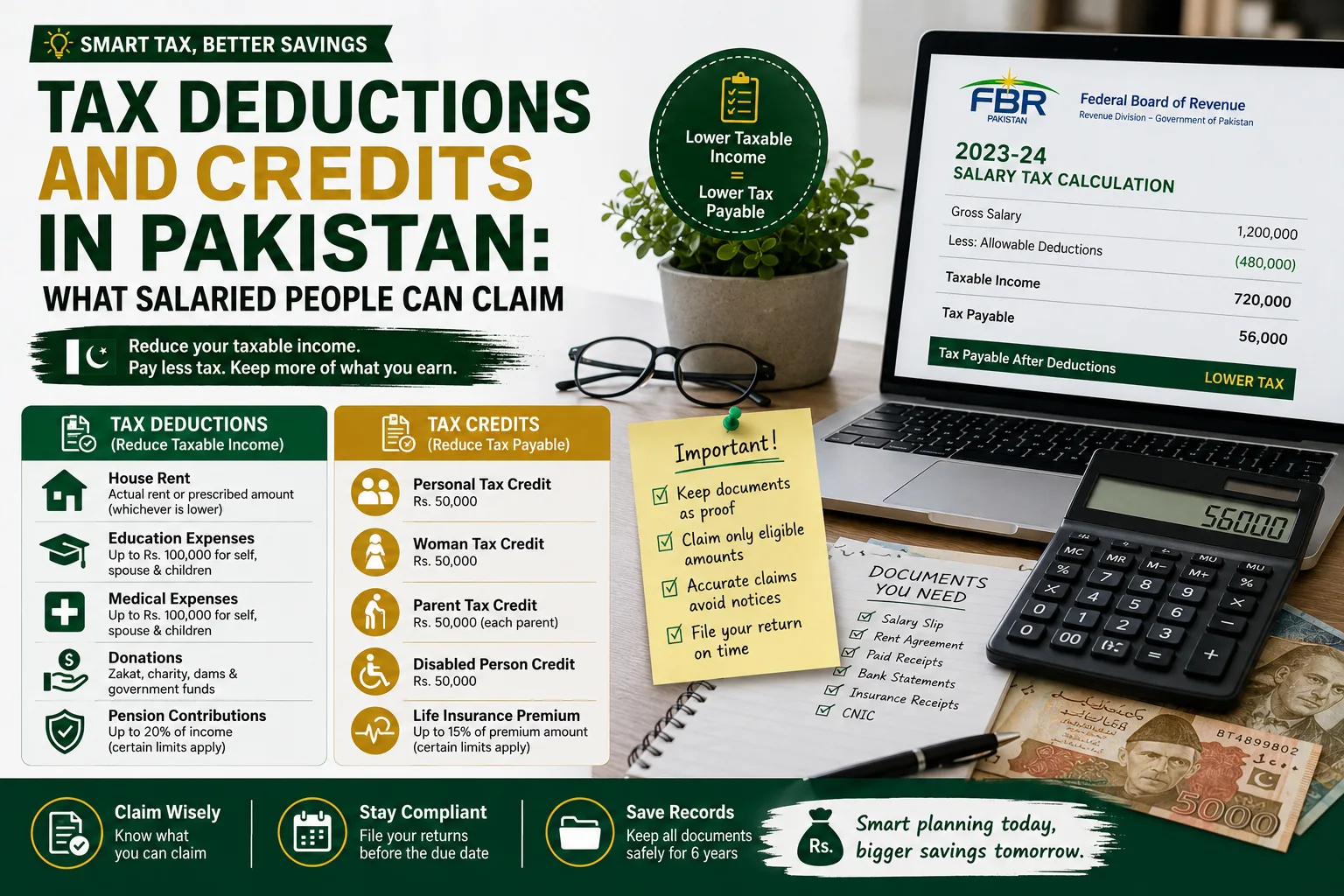
Most salaried Pakistanis pay exactly the tax their payroll department calculates, and never ask the question that businesses ask constantly: what am I legally allowed to subtract? The Income Tax Ordinance contains genuine, above-board ways for employees to reduce taxable income or the tax itself — no creativity required, just paperwork. Here are the ones that matter, how each works, and the arithmetic that shows what they're worth. (Rules and limits shift with budgets; treat this as the map, and verify current details with FBR or a tax practitioner before filing.)
First, know the difference: deduction vs credit
A deduction (or exemption) reduces your taxable income before the slab rates apply — so it saves tax at your highest marginal rate. A tax credit reduces the computed tax, typically in proportion to your average tax rate. Same goal, different arithmetic, and the distinction decides how much a rupee of paperwork is worth to you. Our tax deduction calculator handles the deduction side automatically.
1. Provident and pension fund contributions
Contributions to a recognised provident fund enjoy the ordinance's friendliest treatment: your own contributions within statutory limits get tax relief, employer contributions within limits aren't taxed as your salary, and the fund's accumulated interest is exempt on qualifying withdrawal. Voluntary Pension Scheme (VPS) contributions have historically earned a tax credit up to a percentage of taxable income. If your employer offers a fund and you're not contributing the maximum matched amount, you are declining free money twice — once in the match, once in the tax relief.
2. Medical allowance
Where an employer doesn't provide medical treatment or reimbursement, medical allowance up to 10% of basic salary is commonly exempt from tax. On a basic salary of PKR 1,200,000, that's up to 120,000 of income the slabs never touch — worth 24,000 a year to someone whose top slab is 20%. Payroll usually applies this automatically, but it's worth checking your salary structure actually separates the allowance.
3. Zakat
Zakat deducted at source under the Zakat and Ushr Ordinance (the bank deduction on the 1st of Ramadan) is deductible from taxable income. Zakat you pay privately can also be claimed when documented properly. Since zakat is 2.5% of qualifying wealth — computed cleanly by our zakat calculator — the tax relief effectively refunds part of it at your marginal rate.
4. Charitable donation credits
Donations to institutions approved under the ordinance earn a tax credit computed on the donated amount (capped as a fraction of taxable income — commonly 30% for individuals). The credit is worth roughly your average tax rate times the donation. Two practical rules: donate by crossed cheque or bank transfer, never cash, and keep the receipt showing the organisation's approval status. Donations to unapproved outfits earn nothing, however worthy.
5. The teacher/researcher reduction and other specifics
Full-time teachers and researchers at recognised institutions have historically enjoyed a percentage reduction in tax payable (subject to budget-year changes). Behbood savings certificate profit enjoys capped tax treatment. If you fit a special category, check the current ordinance — these clauses change more often than the big ones.
A worked example
Sana earns PKR 3,000,000 a year (250,000/month). Her recognised provident fund takes 200,000 of her own contributions; her package includes a 100,000 exempt medical allowance. Taxable income falls to 2,700,000. Tax drops from 276,000 to 216,000 — 60,000 saved, i.e. 20% (her marginal rate) of the 300,000 deducted. She also gave 150,000 by cheque to an approved charity: with tax of 216,000 on 2,700,000 (average rate 8%), the credit is roughly 150,000 × 8% = 12,000 more. Total legal saving: about 72,000 rupees for filing correctly. Run your own numbers in the deduction calculator and the salary tax calculator.
How to actually claim
- Through payroll: exemptions your employer administers (fund, medical allowance) should appear in your monthly withholding automatically — check a payslip.
- Through your return: credits for donations and anything payroll missed are claimed when you file (IRIS portal, normally by 30 September). Excess withholding comes back as a refund or adjustment.
- Keep evidence for six years: fund statements, donation receipts, zakat deduction certificates, salary certificates. Claims without paper melt under audit.
None of this is aggressive tax planning — it is the ordinance working as designed, used mostly by people who read it. An hour of paperwork a year, at the savings computed above, may be the best hourly rate you'll ever earn. For the fuller picture of how your slab tax is computed in the first place, see Pakistan income tax 2026-27 explained.
The paperwork calendar that makes claims painless
Claims fail on documentation, not eligibility — so run the year on a small calendar. July: collect your employer's annual salary and tax-deduction certificate, plus the provident fund statement; check the fund's figures against your payslips while both are fresh. Ramadan (whenever it falls): if banks deducted zakat at source, download the deduction certificate then, not at filing time when portals crawl. Through the year: pay every donation by crossed cheque or bank transfer, and file the receipt (with the charity's approval reference) into one folder the day it arrives — reconstructing December's donation in September is how credits get abandoned. August: pull bank profit-and-withholding certificates from each bank; mobile-tax certificates come from your operator's app in minutes. September: file, claiming everything, using the deduction calculator to sanity-check what the claims should be worth before submitting — a large gap between your estimate and the return usually means a certificate was missed. One evening of folder discipline per year typically recovers tens of thousands of rupees; per hour, it out-earns most of the work that produced the salary. The filing guide walks the final step.