 Genzee
How to File Your Income Tax Return in Pakistan: A Beginner's Guide
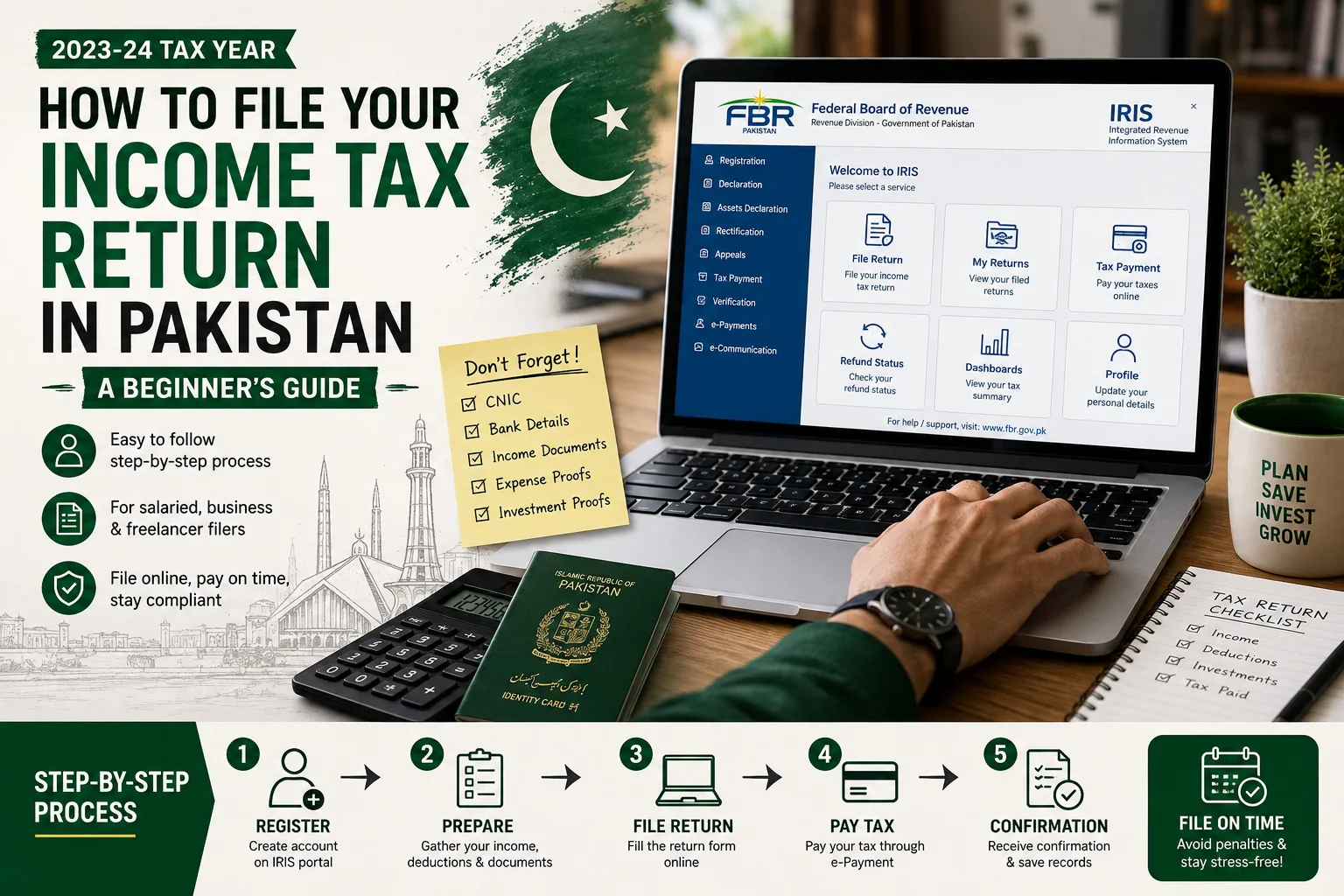
Every year around September, the same conversation happens in offices across Pakistan: "Have you filed?" — "My employer already deducts my tax, why should I?" The answer is that withholding and filing are two different obligations, and skipping the second one costs real money even when the first is fully paid. This guide walks a first-time filer through the whole process — what filing is, why it pays, and the step-by-step mechanics on FBR's IRIS portal.
Why file when tax is already deducted?
- The Active Taxpayers List (ATL). Filers appear on the ATL; non-filers pay dramatically higher withholding rates on banking transactions, vehicle registration and transfers, and property deals — often double. One property transaction as a non-filer can cost more than a decade of filing effort.
- Refunds and credits. Donation credits, teacher reductions, and excess withholding (banks deduct tax on profit regardless of your slab) are only recoverable through a return.
- It's the law. Salaried individuals above the taxable threshold are required to file. Penalties for non-filing exist and have teeth when FBR's data-matching catches up.
- Paper trail. Visa applications, bank loans and business dealings increasingly ask for tax returns as proof of income.
Step 1: Register on IRIS (one time)
Go to FBR's IRIS portal (iris.fbr.gov.pk) and register with your CNIC — your CNIC number is your National Tax Number (NTN) as an individual. You'll need your own SIM-registered mobile number and an email address; codes go to both. Registration is free and takes minutes when the portal cooperates; evenings near the deadline, it often doesn't — register early.
Step 2: Gather the documents
- Salary certificate from your employer showing gross salary and tax deducted (section 149).
- Bank statements for the tax year (1 July – 30 June), plus profit-and-withholding certificates from each bank.
- Withholding certificates for other deductions: mobile operators (yes, that's claimable), vehicle token tax, property transactions.
- Evidence for claims: donation receipts, zakat certificates, provident fund statements.
- Asset details for the wealth statement: property, vehicles, bank balances, gold, loans given and taken, at cost.
Step 3: Fill the return
In IRIS, open the return for the relevant tax year (Tax Year 2027 = income from 1 July 2026 to 30 June 2027). For a salaried person the flow is: declare salary income as per your certificate → enter tax already deducted → add other income (bank profit, rent, capital gains) → claim credits and deductions with amounts from your evidence. The portal computes tax under the current slabs — you can sanity-check its figure in ten seconds against our salary tax calculator, and see what your deductions should be worth with the deduction calculator.
Step 4: The wealth statement
Individual filers also submit a wealth statement: assets and liabilities at year-end, plus a reconciliation — last year's wealth + this year's income − expenses = this year's wealth. It intimidates first-timers but is really an honest inventory: list assets at cost (not market value), estimate household expenses realistically, and make sure the equation balances. Large unexplained wealth jumps are what trigger notices, not the statement itself.
Step 5: Submit — and mind the deadline
The standard deadline for salaried individuals is 30 September following the tax year's end (extensions happen, but plan for the date). Submit, save the acknowledgement PDF, and check the ATL when it updates — appearing there is the tangible payoff. If tax is payable beyond what was withheld, IRIS generates a payment slip (PSID) payable through any bank or banking app before submission.
Common first-timer mistakes
- Forgetting bank profit. FBR receives banks' data; returns that omit declared-to-FBR income invite notices. Declare it — the withholding is usually already adjusted.
- Round-number expenses. "Household expenses: 1,000,000" exactly looks estimated because it is. Base it on reality; it must reconcile with your wealth.
- Missing the mobile/vehicle withholding. Small amounts, but they're your money — collect the certificates and claim them.
- Leaving it to 29 September. The portal slows to a crawl at deadline. File in August like the smug people do.
Filing the first return takes an evening; every subsequent year is an hour, because IRIS pre-fills much of your prior data. If your affairs are more complicated — business income, foreign assets, property sales — a tax practitioner's fee (typically a few thousand rupees for salaried returns) buys peace of mind. Either way, get on the ATL: it's the single highest-return financial chore in Pakistan. For understanding the tax being withheld in the first place, start with our slab-by-slab explainer.
After you submit: what happens next
Filing isn't quite the finish line, so know the aftermath. ATL timing: the Active Taxpayers List updates on a published schedule (traditionally the new list takes effect on 1 March based on returns for the latest tax year, with weekly refreshes) — file by the deadline and your filer benefits arrive with the next update; file late and a surcharge payment restores ATL status. Refunds: where withholding exceeded your liability, the excess shows as refundable; small amounts are commonly adjusted against future years, and formal refund claims run through IRIS with their own verification. Keep expectations patient and paperwork perfect. Notices: most first notices are automated mismatches — a bank certificate you missed, a vehicle purchase FBR knows about. Respond within the deadline through IRIS with documents; silence converts a clerical query into an assessment. Revisions: discovered an error after submitting? Returns can be revised within the allowed window — far better than hoping nobody notices. Finally, archive everything — return PDF, wealth statement, every certificate — in one folder per year. Next September, IRIS pre-fills much of your data, your folder answers the rest, and the chore that took an evening this year takes an hour for the rest of your working life.