 Genzee
Buying Gold in Pakistan: Tola, Grams and Smart Purchases
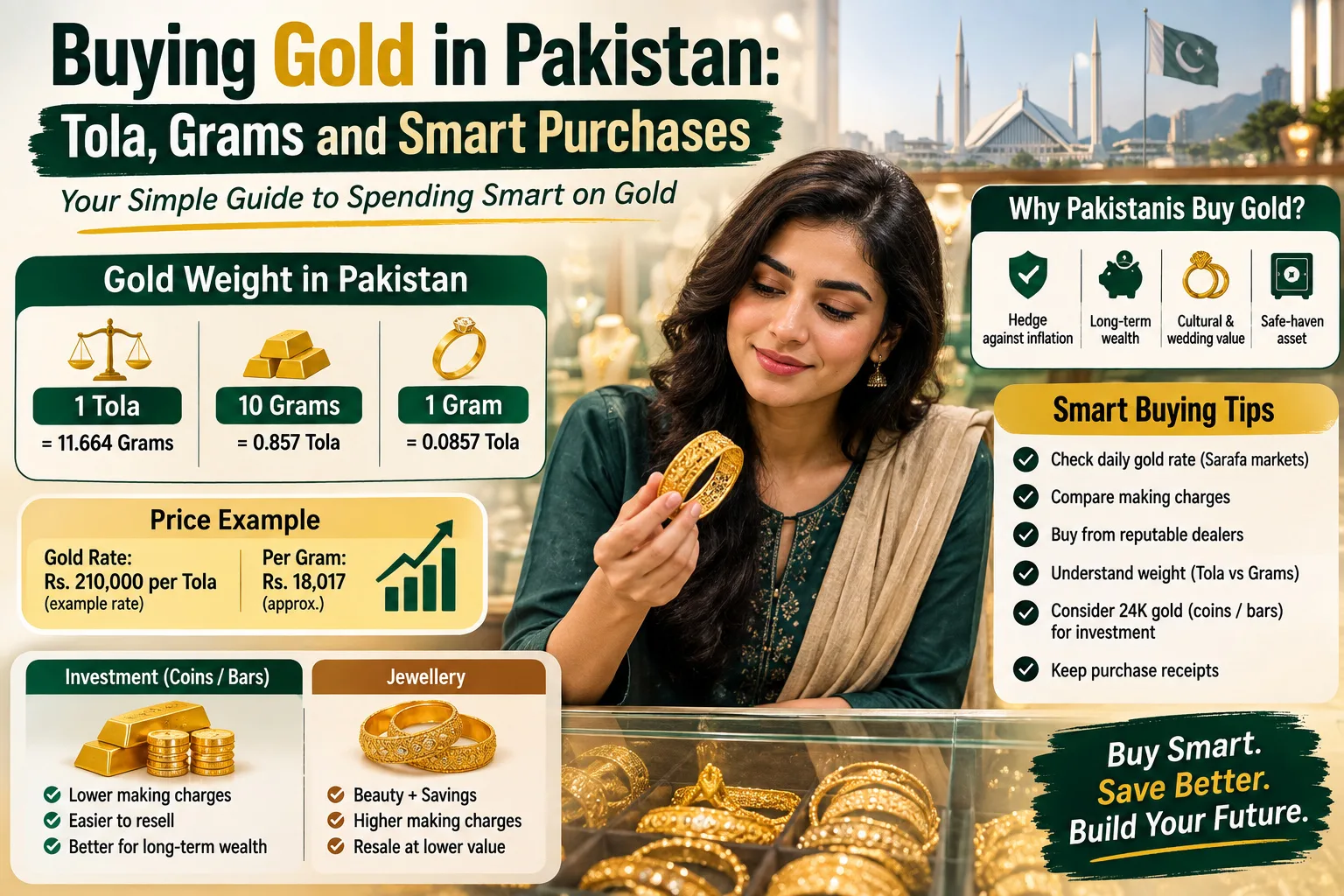
Gold occupies a unique place in Pakistani financial life: it is jewellery, savings account, wedding obligation, inflation hedge and emergency fund rolled into one shiny asset. Yet most gold is bought with less price-checking than a mobile phone. Understanding the units, the purity grades and the fee structure turns you from a price-taker at the jeweller's counter into an informed buyer — and can save tens of thousands of rupees on a single wedding set.
Tola vs gram: speak both languages
Pakistani jewellers quote per tola; international prices come per gram or per ounce. The conversion every buyer should know:
So when the international price moves, divide the per-ounce dollar price by 2.667 and multiply by the exchange rate for a sanity-check per-tola figure. Our unit converter handles tola–gram both ways instantly — and the units guide covers the history of these measures.
Karats: what 22K really means
Pure gold is 24 karat — too soft for daily-wear jewellery. Pakistani jewellery is typically 22K (91.6% gold), stamped "916"; some pieces are 21K (87.5%). The quoted market rate is for 24K, so a fair 22K price is the 24K rate × 0.916. A jeweller charging the full 24K rate for 22K jewellery is pocketing 8% before any other fees. Always confirm: the karat stamp, the weight on a digital scale in front of you, and which purity the quoted rate refers to.
The real cost: making charges and wastage
Jewellery is gold plus labour. Jewellers add making charges (commonly 5–15% of the gold value, or a flat per-tola figure) and sometimes "wastage" — and here's the part that matters: when you sell jewellery back, you recover only the gold value, minus a buyer's margin. Making charges are consumption, not investment.
Worked example: a bride's set weighing 5 tola of 22K, with the 24K rate at PKR 280,000/tola. Gold value: 5 × 280,000 × 0.916 ≈ 1,282,400. With 10% making charges, the bill is ~1,410,600. Sold back next year at unchanged prices, the family recovers perhaps 1,240,000 (gold value minus ~3% dealer margin) — the ~170,000 difference was the cost of it being jewellery rather than gold. Verify any quote's arithmetic on the spot with the percentage calculator.
Jewellery vs investment gold
- Jewellery: beautiful, wearable, culturally necessary — and the worst-performing way to hold gold, because of making charges both ways.
- Coins and small bars: minimal premium over gold value, easy to sell, easy to buy incrementally (a 1-gram coin per month is a real savings plan). The best default for savings-motivated buying.
- Digital/paper gold: emerging options tracking the gold price without storage risk — convenient, but understand who actually holds the metal before trusting large amounts.
Storage deserves one honest sentence: home storage risks theft, bank lockers cost an annual fee and access is limited to banking hours — price that into the decision.
Gold as an investment: the sober view
In rupee terms gold has been a powerful long-run store of value — largely because it hedges both global gold prices and rupee depreciation. But it pays no profit or dividend, can stagnate for years, and a wedding-season purchase at a local price spike can take a long time to break even. The balanced approach treats gold as one shelf of the savings cupboard — alongside an emergency fund and return-bearing savings (see the compound interest calculator for what those do over time) — rather than the whole cupboard.
Zakat on gold: don't forget it
Gold you hold is zakatable wealth. In the Hanafi position followed by most Pakistanis, that includes jewellery in personal use. At 2.5% per lunar year on the market value, a 10-tola holding at today's prices owes a meaningful amount — compute yours precisely with the zakat calculator (it takes grams, so convert tola first) and see the step-by-step zakat guide.
The buyer's checklist
- Check today's rate from two independent sources before entering the shop.
- Confirm karat (stamp), weight (on the scale, in front of you), and which purity the rate quoted refers to.
- Ask for making charges as a separate line — then negotiate them; they are the negotiable part.
- Get a detailed receipt: weight, karat, rate, charges. It's your resale evidence and your zakat record.
- For savings purposes, prefer coins/bars over jewellery, and buy on a schedule rather than at wedding-season peaks.
Selling gold well: the other half of the transaction
Everyone researches buying; almost nobody researches selling, which is where the buying mistakes get invoiced. Expect three deductions when selling jewellery: the making charges evaporate (you're selling metal, not craftsmanship), a dealer margin of roughly 2–5% under the quoted rate, and sometimes a purity re-test ("kasoti") whose result you should watch being performed. Practical protocol: know the day's rate before entering, get quotes from two shops (preferably including the original seller — many honour better buy-back terms for their own receipted pieces), insist on weighing before discussion of price, and bring the purchase receipt, which converts the conversation from appraisal to arithmetic. Coins and bars sell closer to spot precisely because there's nothing to argue about — another point for them as the savings vehicle. Timing-wise, resist selling into the wedding-season demand trough for sellers (prices paid for old jewellery lag when shops are flush with trade-ins); gold's job in a household is the long hold and the genuine emergency, and the emergency fund exists so that the emergency sale — the worst-priced transaction in all of personal finance — never has to happen. Convert weights and sanity-check every figure with the unit converter on the way in and out.