 Genzee
Marla, Kanal and Tola: Pakistan's Land and Gold Units Explained
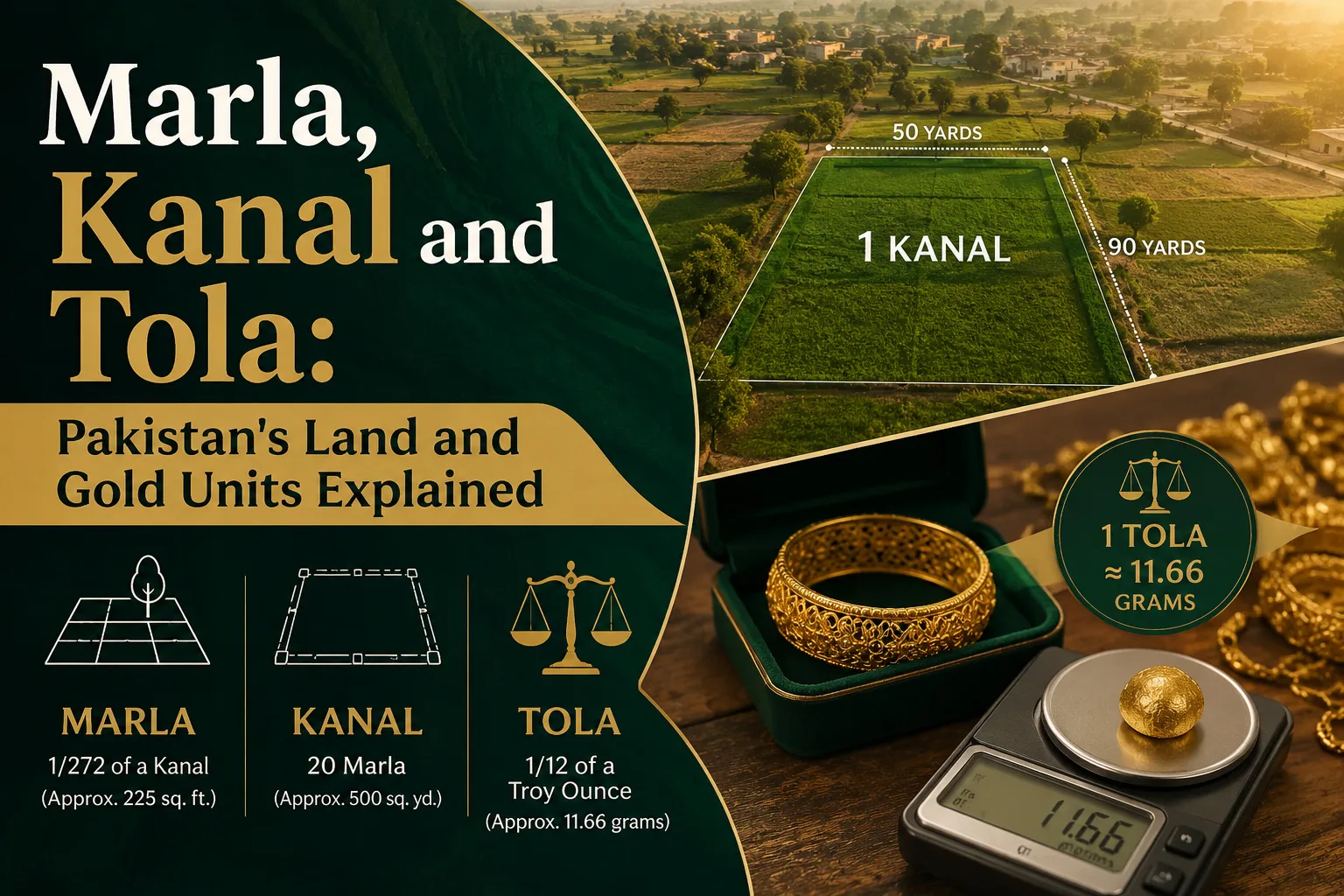
Buy property or gold anywhere in Pakistan and the conversation runs on units no calculator app ships with: a 5-marla house, a 2-kanal farmhouse, a 5-tola wedding set. These measures predate the metric system by centuries, survived the British standardisation that fixed their modern values, and remain the living language of two of the country's biggest markets. Knowing them precisely — including where they vary by region — is basic financial literacy here. This is the complete field guide.
The land units: marla and kanal
The standard (British-era) values used across most of urban Pakistan:
The mental anchors: a marla is roughly a 16.5 × 16.5 ft square — a modest room and a bit; a kanal is a serious plot; 8 kanal make the acre familiar from farming. A "5-marla house", the workhorse of Pakistani middle-class real estate, sits on about 1,361 sq ft of land; a "10-marla" on ~2,722; a "1-kanal" residence on ~5,445. Convert any figure instantly with the unit converter, which speaks marla, kanal, acre and hectare natively.
The regional trap: the 225-square-foot marla
Here's the expensive footnote: in some areas — parts of KP and various older/rural settlements — the customary marla is 225 sq ft (a 15 × 15 ft square, from a 9-foot rather than 9.9-foot gaz tradition), not 272.25. That's a 17% difference: a "10-marla" plot could be 2,722 sq ft or 2,250 depending on local convention. The defence is absolute: for any transaction, confirm the plot's area in square feet on the registry documents, and treat marla counts as marketing shorthand. Housing societies' own specifications (some use 250 sq ft internally) add further variety — the documents, not the brochure, are the truth.
The gold unit: tola
The tola descends from ancient South Asian coin weights (the rupee coin itself was historically one tola of silver) and was standardised under British rule at 180 grains:
nisab reference: 7.5 tola gold = 87.48 g · 52.5 tola silver = 612.36 g
Jewellers quote per tola; international markets per ounce or gram. To sanity-check a local quote against the world price: dollar price per ounce ÷ 2.667 × exchange rate ≈ fair per-tola figure (before local premiums). Jewellers also subdivide: a tola splits into 12 masha, and older trade language uses ratti (8 ratti = 1 masha) — you'll still hear both in Sarafa bazaars, though digital scales in grams are mercifully standard now.
Worked examples
- Property listing: a "7-marla" plot in a standard-convention city = 7 × 272.25 ≈ 1,906 sq ft (177 m²). At PKR 350,000 per marla, that's 2.45 million — and now you can compare per-square-foot (≈ 1,285/sq ft) against a nearby listing quoted in sq ft directly.
- Gold purchase: a 5-tola set = 5 × 11.6638 = 58.32 grams. At a 24K rate of PKR 24,000/gram with 22K jewellery (×0.916), fair gold value ≈ 1.28 million before making charges — the full price anatomy is in our gold buying guide.
- Zakat: holdings of 8 tola exceed the 7.5-tola gold nisab, so zakat applies — convert to grams and compute the exact amount with the zakat calculator and the step-by-step guide.
Why these units persist (and why that's fine)
Markets run on shared shorthand, and marla/kanal/tola compress exactly the quantities Pakistanis transact in most: residential plots and wedding gold. The units aren't the problem — unverified conversions are. The working rules: know the standard values (272.25, 5,445, 11.6638), suspect regional variation on land, verify square footage on documents, weigh gold on the scale in front of you, and keep the converter a tap away for everything else — it also handles the lengths, weights and temperatures that daily life throws in between.
Due diligence: reading the documents behind the units
Unit fluency matters most at transaction time, when it meets paperwork. For property, the registry documents (registry/intiqal, or the society's allotment and transfer letters) state area in the legally operative figures — confirm the sq ft or marla figure there matches the listing, ask explicitly which marla convention the society uses, and for constructed houses distinguish land area (what "10 marla" describes) from covered area (the built floors, often nearly double the land figure across two storeys — and the number renovation quotes and many valuations actually use). A dimensioned site plan beats any verbal assurance: multiply the plot's stated dimensions yourself and compare — the percentage calculator and unit converter make the cross-check a minute's work. For gold, the receipt is the document that matters: weight in grams and tola, karat, rate applied, and making charges itemised — a receipt with only a total price is a receipt designed for the seller's benefit at buy-back time. In both markets the pattern is identical: the units are shared language, the documents are the contract, and the buyer who checks that the two agree — before money moves — is the buyer these guides were written for.