 Genzee
Emergency Funds: How Much You Need and How to Build One
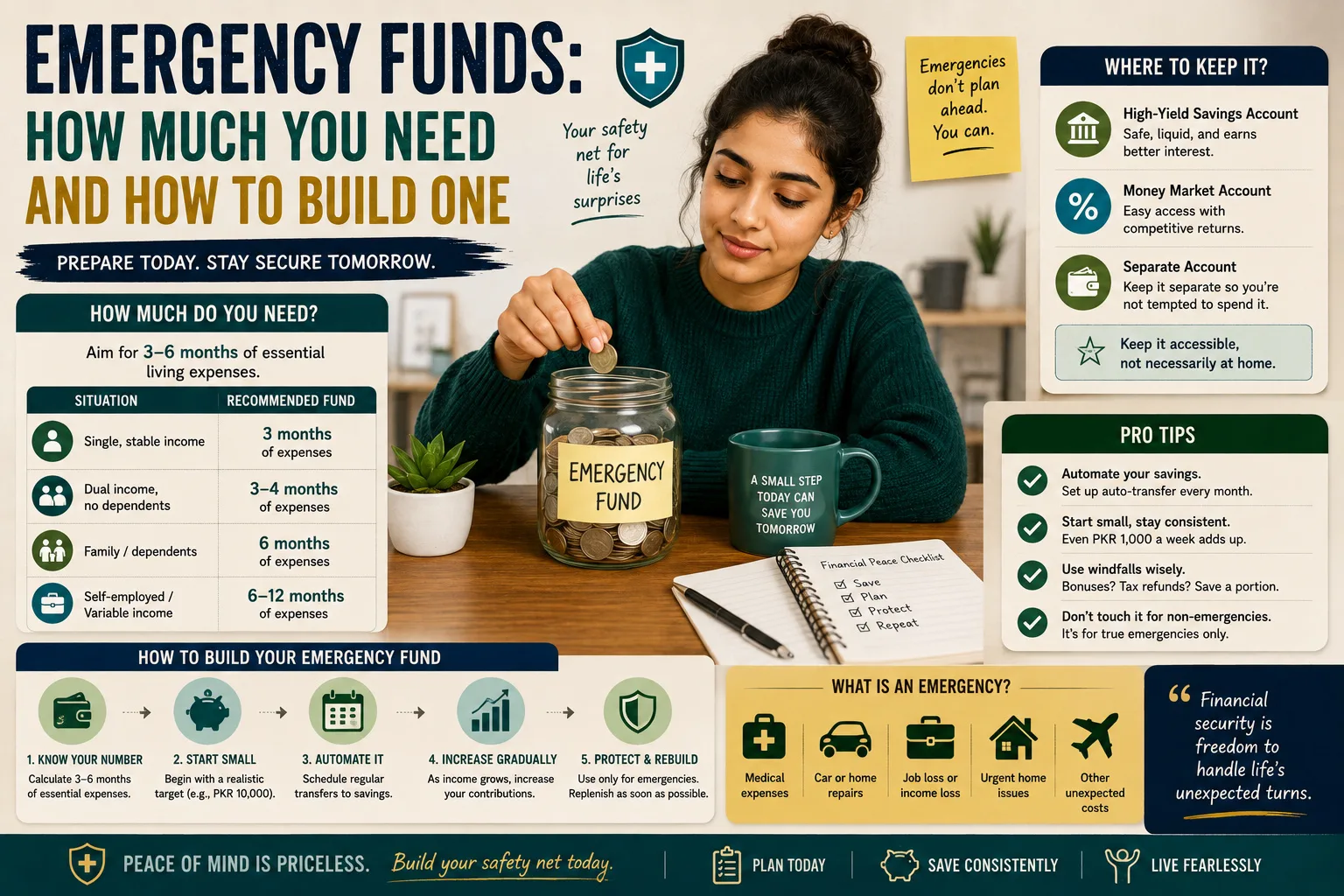
Financial plans don't usually die from bad investments. They die from a burst water pipe, a retrenchment email, a parent's hospital bill — an ordinary emergency arriving before any cushion exists, forcing expensive debt that takes years to unwind. The emergency fund is the least glamorous object in personal finance and by far the most important one. Here is how much you need, where to keep it, and a realistic way to build it on a Pakistani income.
What counts as an emergency fund
Money that is: (1) reserved exclusively for genuine emergencies — job loss, medical events, urgent home/vehicle repair; (2) liquid — available within a day or two without penalty; and (3) boring — parked somewhere safe, not invested in anything that can be down 30% the week you need it. It is insurance you pay yourself, and its return is measured in disasters that stay small.
How much? The months-of-expenses rule
The standard prescription is 3 to 6 months of essential expenses — not income, expenses. Where you sit in that range depends on how fragile your income is:
- 3 months: stable salaried job, working spouse, employer health cover.
- 6 months: single income household, dependents, rented home.
- 6–12 months: freelancers and business owners, where "the client paid late" is a lifestyle — see the freelancer guide.
Compute it honestly: add rent, groceries, utilities, school fees, transport, medicines and committed family support. If essentials cost PKR 90,000 a month, the target is 270,000–540,000. Big number? It's built monthly, like everything else.
Where to keep it (and where not to)
- Good: a separate savings account at your own bank (instant transfer, some profit), a savings account at a different bank (adds friction against impulse raids), or a money-market fund with 1–2 day redemption for the upper layers.
- Acceptable for part: short National Savings instruments for the "months 4–6" layer you're least likely to need suddenly.
- Bad: stocks and crypto (can be down exactly when you need them), gold in a locker (illiquid on a Sunday night, price-volatile), committees (your payout month rarely coincides with your emergency), and your everyday account (it will be spent — this is a law of nature).
The classic structure: first month's worth instantly accessible, the rest one small step away earning whatever a savings product honestly pays.
Building it: a worked plan
Take-home PKR 150,000, essentials 90,000, target 3 months = 270,000. Following the 50/30/20 rule, savings capacity is ~30,000/month, of which 20,000 goes to the fund. The savings goal calculator puts 270,000 at 20,000/month with a 10% savings rate at about 13 months. Accelerators: bank any bonus or Eidi straight in (a single 50,000 bonus cuts ~2.5 months), sell something unused, or divert the wants budget for a defined 90-day sprint. Most households can stand up a 3-month fund inside a year — and the psychological change arrives even earlier, around one month's worth, when small disasters stop being debt events.
The rules of use
- Define "emergency" before one happens: unplanned, necessary, urgent. Wedding season fails all three; a burst geyser passes.
- Spend it when it qualifies. The fund is not sacred — hoarding it while swiping a credit card at 40% APR defeats the purpose.
- Refill before resuming other goals. A used fund is a success story mid-sentence; finish the sentence.
- Recalculate yearly. Inflation raises essential costs, so the same "3 months" is a bigger number each year — the percentage calculator makes quick work of the adjustment.
Why this beats investing (until it's done)
Mathematically, a savings account loses to inflation and to almost any investment's expected return — and none of that matters, because the fund's job isn't return, it's preventing forced borrowing and forced selling. Credit card debt at 40% APR, or selling investments in a down market, costs far more than the return you "sacrificed" by keeping cash. Build the cushion first; then invest with the calm of someone who can survive a bad quarter. The compound interest calculator will still be there, and you'll use it from a position of strength.
Special cases: whose fund needs adjusting?
The 3–6 month rule assumes an average household; several common situations move the target. Joint family systems — where earners effectively insure each other — can justify the lower bound per earner, provided the mutual support is real and not merely assumed; one honest conversation beats an optimistic guess. Single earners with dependants sit at the opposite pole: six months is the floor, and employer health coverage (or its absence) should move the number further. Government employees with high job security can hold less cash and start investing earlier; contract and gig workers should treat nine months as normal, not paranoid. Business owners need two separate funds — personal and business working-capital — because mixing them means one bad quarter raids the family's cushion. And anyone supporting parents' medical needs should hold a separate medical layer, since health emergencies are both the likeliest and the least deferrable draw. Whatever your number, revisit it after every major life change — marriage, a child, a job switch, a rent increase — because the fund protects a lifestyle, and the lifestyle keeps changing. The goal calculator re-plans the top-up schedule in seconds; the discipline of actually running it belongs to you.