 Genzee
Simple vs Compound Interest: The Difference That Costs You Money
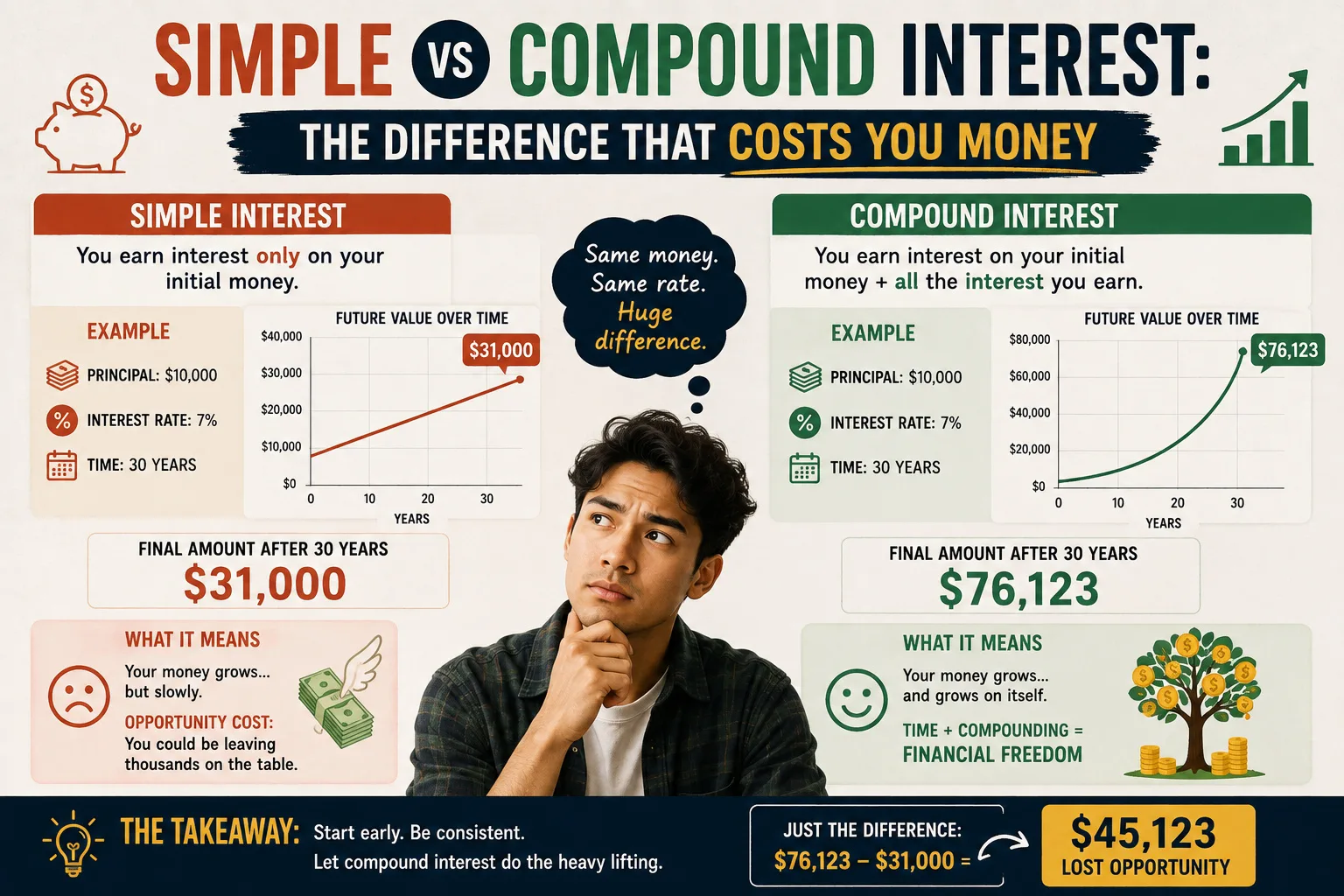
Two loans at "12%" can cost wildly different amounts. Two savings products at "10%" can grow your money at wildly different speeds. The hidden variable is the same in both cases: whether the interest is simple or compound — calculated on the original amount only, or on the growing balance. It's a one-word difference in a contract and a six-figure difference over a working life. Here's the distinction, the arithmetic, and the places each one hides.
The two mechanisms in one table
PKR 100,000 at 12% per year:
Year one is identical — compounding needs time to work. By year five the gap is visible; by year twenty the compound balance is nearly three times the simple one. Simple interest grows in a straight line (the same 12,000 every year); compound grows in a curve that keeps steepening, because each year's interest joins the base for the next. Try any combination yourself in the simple interest calculator and the compound interest calculator.
The formulas, side by side
Compound: A = P × (1 + r ÷ 100)ᵗ
One multiplies the rate by time; the other raises it to the power of time. Multiplication versus exponentiation — the entire difference between arithmetic that plods and arithmetic that snowballs. (Compounding more often than yearly — monthly, daily — steepens the curve slightly further.)
Where you meet each one
- Simple interest: informal personal lending ("12% per year on the amount"), some savings certificates' quoted profit, court-ordered interest, trade credit terms, and consumer "flat rate" financing (more on that trap below).
- Compound interest: bank deposits and savings accounts, credit card balances (compounding monthly against you), investment returns, inflation itself — and bank loans, which use a reducing-balance method that is compounding's well-behaved cousin (see how EMIs work).
The flat-rate loan trap
The most expensive place this distinction hides is consumer financing quoted at a "flat" (simple) rate with monthly installments. A "7% flat" 3-year loan on PKR 600,000 charges 7% × 3 × 600,000 = 126,000 interest — on the full principal for the whole term, even though your installments repay that principal month by month. On average you owed only about half the principal, so the true reducing-balance rate is nearly double — around 13%. Comparison method: compute the flat deal's total interest with the simple interest calculator, then find what reducing rate produces the same total in the EMI calculator. Compare that rate with the bank's quoted APR. Dealers rely on nobody doing this arithmetic; it takes ninety seconds.
Compounding against you: the credit card
A card charging ~3.3% a month compounds to roughly 48% a year — an unpaid 100,000 balance becomes ~148,000 in twelve months with no new spending. The same exponential curve that builds savings demolishes borrowers, which is why expensive compound debt outranks nearly every other financial priority — the debt payoff guide covers the order of attack.
The takeaways
- Savings: demand compounding. Confirm profit is reinvested/compounded, not paid flat — over decades it's the whole game, as the compound interest deep-dive shows.
- Borrowing: translate everything to reducing-balance terms. "Flat" and "simple" quotes on installment loans understate the true rate by roughly half.
- Time is the multiplier. Over months, simple vs compound barely matters; over decades, it's a 3× difference. Long money deserves the most scrutiny.
- When quoted any rate, ask the only question that matters: "interest on what balance — original, or outstanding?" The answer tells you which formula, and which calculator, applies.
A checklist for reading any interest offer
Before signing or depositing, run the offer through five questions. (1) Interest on what balance? Original amount = simple/flat; outstanding or accumulated balance = compound/reducing. This single answer selects the right calculator and exposes flat-rate installment traps immediately. (2) What's the compounding frequency? Monthly compounding at the same nominal rate beats yearly — for deposits ask "when is profit credited, and does it reinvest?" (3) What's the effective annual rate? Any honest lender or fund can state the APR/effective yield; a quote that resists being converted to one is hiding something. (4) What are the fees? Processing fees on loans and front-end loads on funds act like extra interest — fold them in before comparing. (5) What does the total cost/return come to in rupees? Percentages mislead; totals don't. Compute the full-term rupee figure with the simple interest, compound interest or EMI calculator and compare offers on that number alone. Five questions, five minutes — and you will never again be the customer the "7% flat" banner was designed for.