 Genzee
Debt Snowball vs. Avalanche: Which Payoff Method Actually Saves More
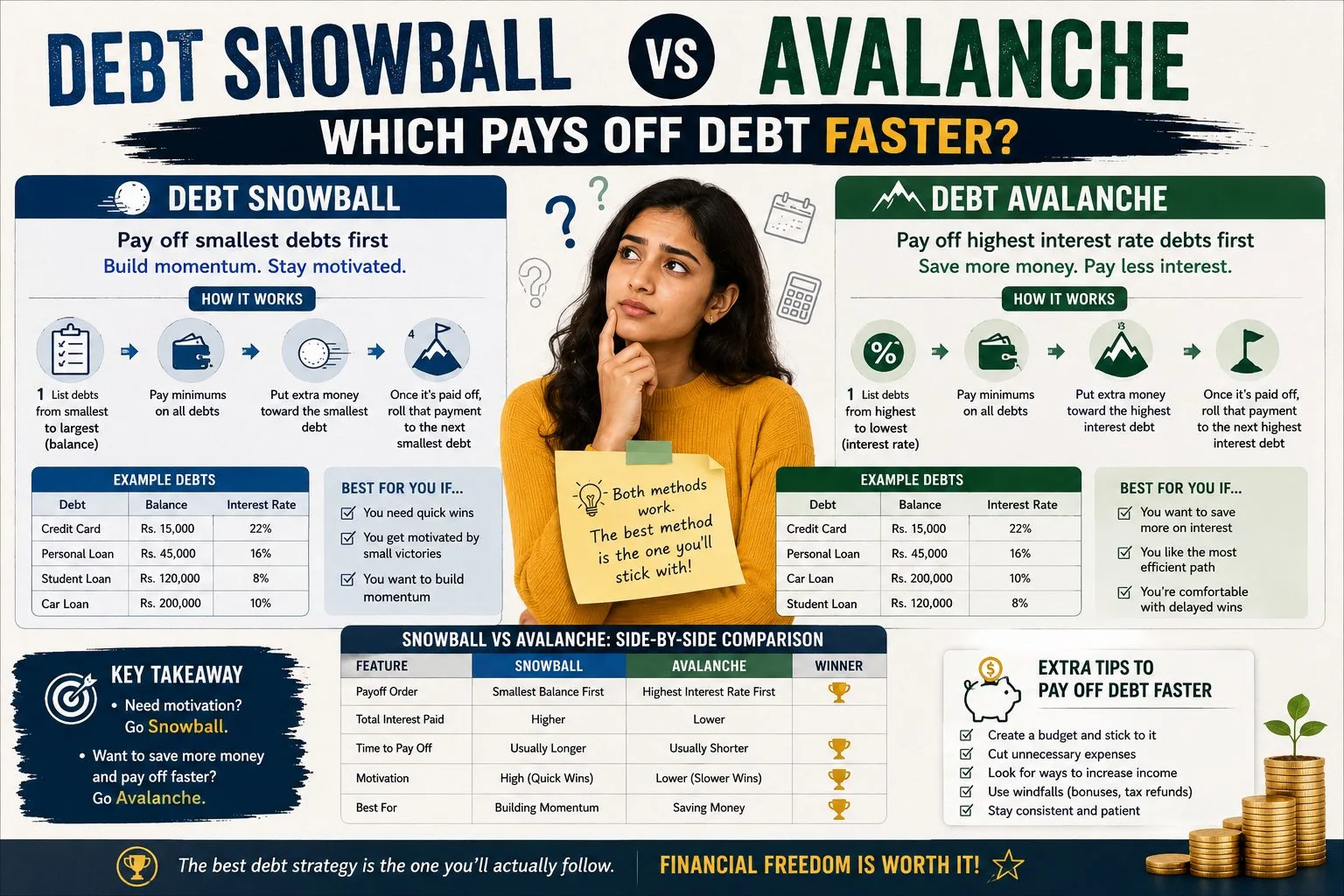
If you have more than one debt — a credit card, a personal loan, maybe a student loan — the order you pay them off in changes both how much interest you pay overall and how it feels along the way. Two methods dominate the advice: snowball and avalanche.
The avalanche method
Avalanche puts every spare rupee toward whichever debt has the highest interest rate, while paying only the minimum on everything else. Once the highest-rate debt is cleared, you roll its entire payment into the next-highest-rate debt, and so on. Mathematically, this is the cheapest way to clear multiple debts — every rupee of extra payment goes toward the debt currently costing you the most.
The snowball method
Snowball instead targets the smallest balance first, regardless of its interest rate, again paying only minimums elsewhere. The appeal isn't the math — it's momentum. Clearing an entire debt, even a small one, produces a visible win faster, which behavioral research on debt repayment has found meaningfully improves the odds that people stick with a payoff plan through to the end.
Which one actually saves more?
Avalanche wins on total interest paid, every time, by definition — it's mathematically optimal. The gap between the two methods grows with the difference in interest rates across your debts: if a high-interest credit card sits alongside a low-interest loan, avalanche's advantage is significant. If all your debts carry similar rates, the two methods end up close to identical in total cost, and the choice becomes mostly about which keeps you motivated.
Try running your own debt through a payoff calculator at its actual rate and payment — the time-to-payoff and total-interest figures make the trade-off concrete rather than theoretical.
A practical middle ground
Some people use a hybrid: snowball the smallest debt first for an early motivational win, then switch to avalanche ordering for everything after that. There's no rule that says the method has to be pure — the "best" method is ultimately whichever one you'll actually follow through on until every balance reaches zero.
A worked comparison
Picture three debts: a credit card at 300,000 and 24% APR, a personal loan at 150,000 and 15% APR, and a small store card at 40,000 and 30% APR. Under avalanche, every spare rupee goes to the store card first (highest rate), then the credit card, then the personal loan. Under snowball, the order flips to store card, then personal loan, then credit card, based purely on balance size rather than rate. In this example the two methods actually agree on which debt to tackle first, since the store card is both the smallest balance and the highest rate — a useful reminder that the two strategies often overlap more than the framing suggests.
What actually derails a payoff plan
The research behind the snowball method's popularity is not really about interest math; it is about behavior. Multi-debt payoff plans most commonly fail not because the wrong debt was targeted first, but because momentum stalls after months with no visible progress. A method that clears one full debt sooner, even at a small mathematical cost, can be worth it if it is the difference between finishing the plan and abandoning it halfway.
The one thing that matters more than either method
Whichever order is chosen, the total extra payment amount matters far more than the sequencing. Doubling the extra monthly payment cuts both time and total interest more than switching between snowball and avalanche ever will. If there is spare budget to find — cutting a subscription, a temporary side income — putting it toward whichever method is already chosen beats agonizing over which method is theoretically a few percent more efficient.