 Genzee
Rental Property Investing 101: What Rental Yield Actually Tells You
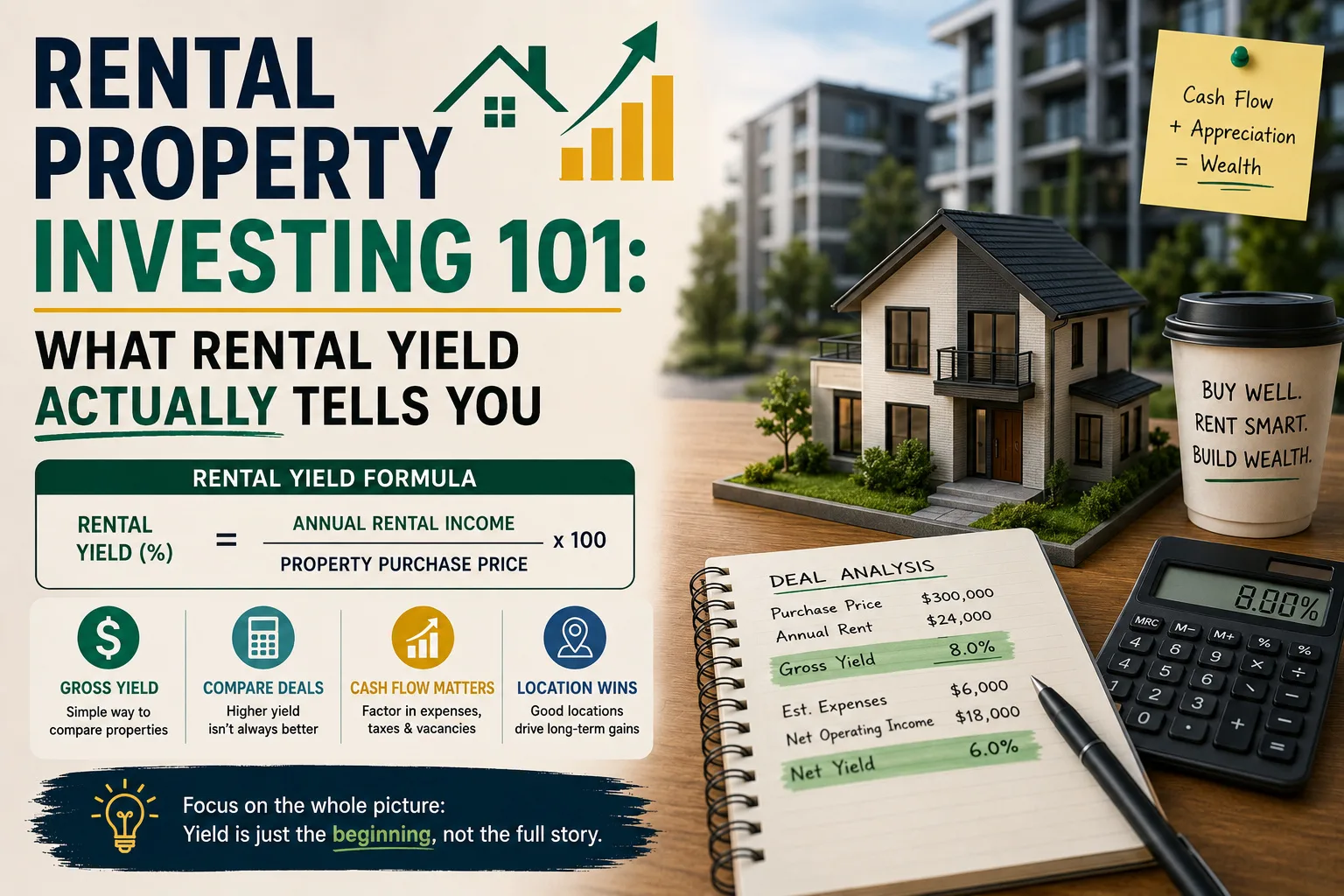
Rental yield is the single most-quoted figure in property investing conversations, and also one of the most commonly misunderstood. It measures a property's rental income relative to its price — but which version of "yield" gets quoted changes the picture significantly.
Gross yield: the quick, rough number
Gross yield is simply annual rental income divided by the property's price. It's fast to calculate and useful for a first-pass comparison across multiple properties, but it ignores every ongoing cost of actually owning the property — maintenance, property tax, insurance, and management fees if you use an agent.
Net yield: the more honest number
Net yield subtracts those annual running costs from the rental income before dividing by the price. Two properties with an identical gross yield can have very different net yields depending on their upkeep costs — an older property needing frequent repairs will often look far less attractive once running costs are factored in, even if its headline gross yield looked competitive.
What yield leaves out entirely
Yield says nothing about capital appreciation — whether the property's value itself is likely to rise or fall over the holding period — nor does it factor in financing costs if the purchase is mortgaged rather than bought outright. A property with a modest yield in a rapidly appreciating area can still outperform a high-yield property in a stagnant one, once total return (yield plus appreciation) is considered.
Yield also doesn't price in risk
A high yield can be a genuine bargain — or a signal that the market is pricing in more risk than the yield figure alone reveals: a higher-crime area, an oversupplied rental market, or a property type prone to costly repairs. Rental yield is a useful first filter for comparing properties, not a complete investment case on its own.
How yield compares across property types
Smaller, lower-priced units — studios and one-bedroom apartments in particular — tend to post higher yields than larger family homes, mainly because rental demand per square foot is generally stronger at the smaller end of the market while purchase prices scale down faster than rents do. This is not a rule without exceptions, but it explains why yield-focused investors are disproportionately drawn to compact units over larger properties, even when the larger property might appreciate more in value over time.
Financing changes the real return, even though yield ignores it
Because yield calculations here assume a cash purchase, a mortgaged buyer's actual cash-on-cash return can look very different — often higher, through leverage, but also more exposed if rents dip or interest rates rise on a variable mortgage. Two investors buying the identical property at the identical yield can end up with very different real outcomes purely based on how the purchase was financed, which is exactly why yield is a comparison tool between properties, not a complete answer for any one buyer's situation.
A practical way to use the number
Calculate net yield for every property under serious consideration, using consistent expense assumptions across all of them, and treat the resulting ranking as a shortlist filter rather than a final decision. From there, the remaining questions — expected appreciation, local rental demand trends, and how the purchase will be financed — determine which property on the shortlist is actually the better investment.