 Genzee
Investing for Beginners: Index Funds, Risk and Starting Small
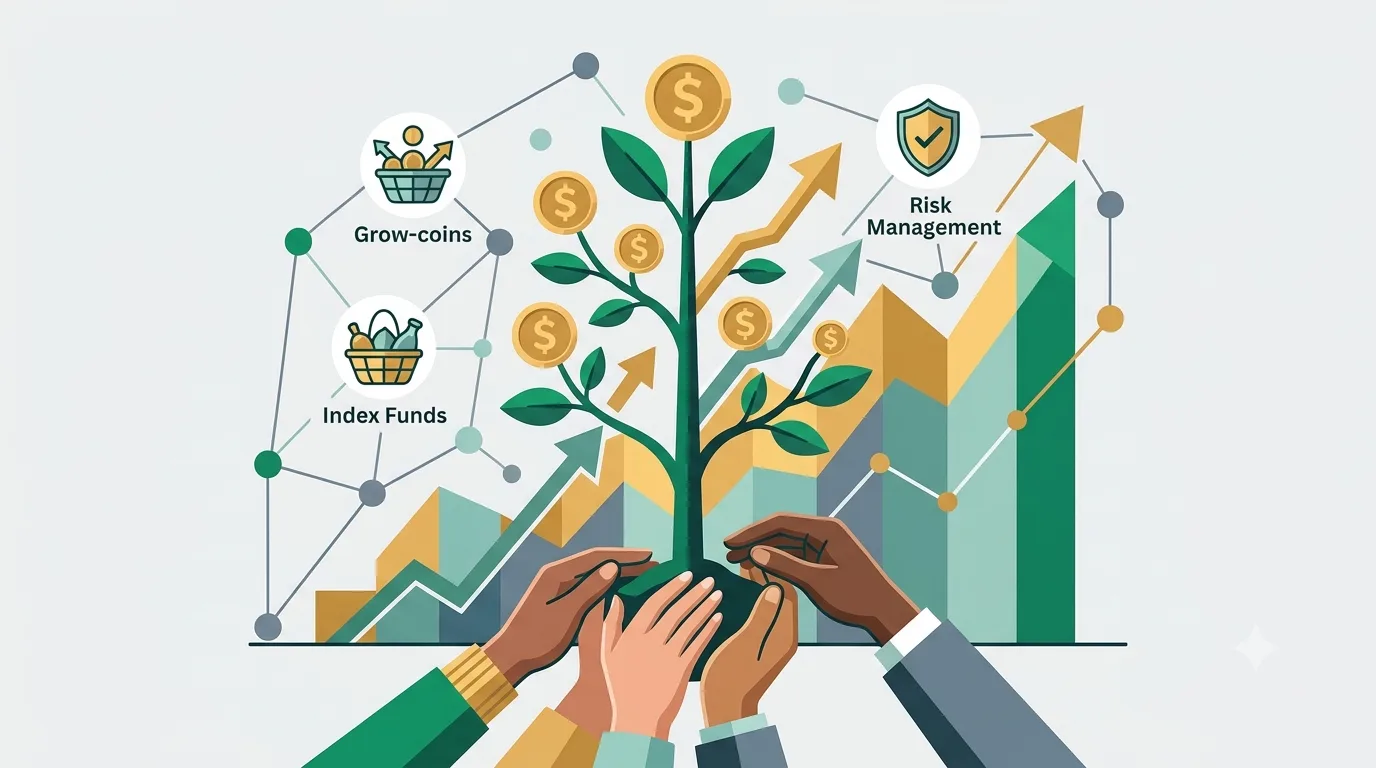
The gap between “I should start investing” and actually doing it is usually filled with a fear of picking the wrong stock. The good news: for most beginners, the entire question of picking individual stocks is avoidable, and arguably shouldn't be the first decision at all. Here's the beginner-relevant version of how index funds, risk and time actually fit together.
Picking stocks vs owning the market
Buying an individual stock means betting on one company's future — its management, its competitors, its industry, all at once. An index fund instead holds a broad basket of many companies (often hundreds or thousands) designed to track a market index, so its return simply mirrors that whole market's average performance rather than any single company's fate. This trades the chance of picking a huge individual winner for a much steadier, more predictable long-run outcome — and for most beginners without the time or expertise to research individual companies deeply, that trade is a reasonable one. It's also dramatically simpler: one purchase gives you exposure to an entire market instead of research into dozens of companies.
Why diversification is the actual point
The value of an index fund isn't that it magically performs better than every stock — some individual stocks will always outperform it. The value is diversification: spreading risk across many companies so that any single company's bad year doesn't sink your entire portfolio. A stock can go to zero; a broad, diversified index basically can't, because that would require every major company in an entire economy failing simultaneously. This is why diversification is often described as the only genuinely “free” risk reduction available in investing — you're not giving up expected return to get it, in a well-constructed broad fund.
Risk tolerance: not a personality trait, a time horizon question
“Risk tolerance” often gets treated as a fixed personality quiz result, but the more useful version of the question is simply: when will you need this money? Money needed within the next year or two shouldn't be exposed to market swings at all — a savings account or similarly stable option is the right tool there. Money you won't touch for five, ten, or twenty-plus years can reasonably absorb short-term ups and downs, because history shows markets have had time to recover from downturns over long horizons, even though no specific future return is ever guaranteed. Matching the investment to the timeline, not to a mood, is the actual skill here.
Dollar-cost averaging: removing the timing problem
Trying to guess the “best” moment to invest is famously difficult, even for professionals. Dollar-cost averaging sidesteps the problem by investing a fixed amount on a regular schedule (say, monthly) regardless of whether prices are up or down that particular month. When prices are low, that fixed amount buys more units; when prices are high, it buys fewer. Over time this averages out your entry price and removes the pressure of trying to time a single perfect purchase — which is exactly why it suits beginners who'd otherwise freeze waiting for the “right” moment that never announces itself.
Why starting early matters more than starting big
This is where investing connects directly to compound interest: money invested earlier has more time cycles to grow on top of its own growth, and that compounding effect is nonlinear — a lot of the total growth in any long-term investment happens in its final years, which only exist if the early years happened first. A smaller amount invested consistently starting today will very often outgrow a larger amount started a decade from now, simply because of the extra time compounding had to work. See the exact math in our compound interest guide.
Model how a monthly contribution grows over time with the compound interest calculator, and use the savings goal calculator if you're working backward from a specific target amount and date.
This is general education, not investment advice — all investing carries risk of loss, past performance doesn't guarantee future results, and you should weigh your own circumstances (or speak with a licensed advisor) before investing any money.
Frequently asked questions
Are index funds safer than individual stocks?They carry less company-specific risk because they're diversified across many companies, so one company's bad news doesn't sink the whole investment. They still rise and fall with the broader market, so they're not risk-free — just differently risky.
Many platforms now allow very small regular contributions, so the realistic barrier for beginners is usually consistency, not a large starting amount. Starting small and contributing regularly tends to matter more than the size of the first deposit.
It means investing a fixed amount on a regular schedule regardless of the current price, which averages your entry price over time and removes the pressure of trying to guess the single best moment to invest — a guess even professionals routinely get wrong.
It's generally considered higher risk and more research-intensive than broad index investing, since your outcome depends heavily on a small number of company-specific decisions. Many beginners start with broad index funds and consider individual stocks later, if at all.
Because of compounding — growth builds on previous growth, and that effect is strongest over long stretches of time. Extra years at the start of an investing timeline are difficult to make up for later, even with larger contributions.