 Genzee
How Pregnancy Due Dates Are Calculated: Naegele's Rule Explained
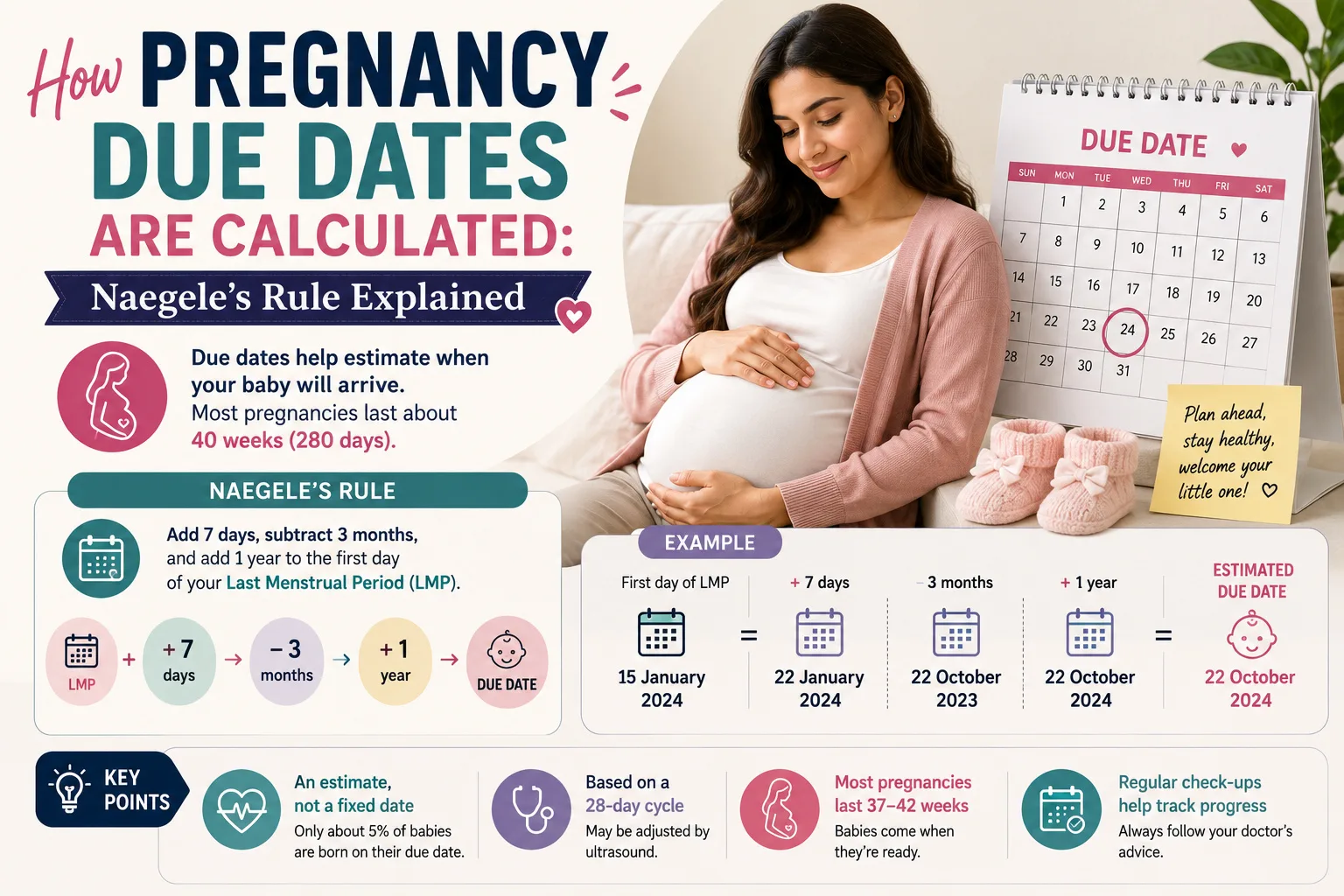
"Your due date is 8 October." Few sentences carry more planning weight — leave applications, travelling relatives, hospital bags — yet few numbers are more widely misunderstood. Only about one baby in twenty-five arrives on the date itself. Understanding how the date is produced, and what it actually promises, replaces anxiety with realistic planning. Here's the calculation, its history, and its honest error bars.
The rule: LMP + 280 days
The standard calculation — Naegele's rule, named for the German obstetrician Franz Naegele who popularised it in the early 1800s — is disarmingly simple: take the first day of the last menstrual period (LMP) and add 280 days (40 weeks). No conception dates, no scans, just calendar arithmetic that a midwife two centuries ago could do — which was precisely its virtue, and why it still anchors obstetric charts today.
(equivalently: LMP + 1 year − 3 months + 7 days)
Why count from a day when pregnancy hadn't started?
Because the LMP is the one date women reliably know. Conception typically happens around ovulation — roughly day 14 of a classic 28-day cycle — so the "40 weeks" of medical pregnancy includes about two weeks of not being pregnant at all. This is also why the maths says a baby is "4 weeks" at what is biologically about two weeks after conception. The convention confuses everyone once, then works fine: everybody counts from the same anchor.
The cycle-length correction
Naegele's 280 assumes ovulation on day 14. Cycles that run consistently long or short shift ovulation — and the due date — by the same amount: a 33-day cycle typically means ovulation ~5 days later, so 5 days are added. Our due date calculator applies this adjustment automatically, along with the current week count and trimester. (Irregular cycles blur the LMP method's precision — which is where the next section takes over.)
Ultrasound: the calculation's editor
An early scan (ideally 8–13 weeks) measures the embryo's crown-rump length, which tracks gestational age within a few days — more accurately than any calendar method. Standard practice: when the scan and the LMP estimate differ by more than about 5–7 days, the scan date wins and is never revised by later scans (third-trimester measurements reflect the baby's individual size, not its age). So treat the calculator's output as the provisional date, and the dating scan as the official one your antenatal team will use.
What "due date" statistically means
It's the median of a wide distribution, not a delivery appointment:
- Only ~4–5% of babies arrive on the exact date.
- The normal window is 37 to 42 weeks — "full term" formally 39w0d–40w6d.
- First pregnancies trend slightly past the date; a few days "late" is the norm, not an alarm.
The practical reframe: think "due fortnight centred on the date". Plan leave, travel and arrangements around the window, not the day — the date difference calculator is handy for counting to the window's edges.
A worked example
LMP on 1 January 2026, regular 28-day cycles: due date = 1 January + 280 days = 8 October 2026. On 1 April she is 90 days along — 12 weeks 6 days, closing the first trimester right around the dating scan. If her cycles ran 33 days, the estimate shifts to 13 October; and if the 12-week scan measures the baby 6 days ahead of that, the official date moves accordingly and stays put thereafter.
Planning notes for Pakistani families
Maternity leave letters typically want the EDD from your doctor — use the scan-confirmed date once you have it. Book the hospital and arrange transport for the whole 37–42 week window, especially where distances or city traffic are factors. And the standard disclaimer, meant sincerely: this article and the calculator explain the arithmetic; bleeding, reduced movements, or anything worrying goes to your doctor, not to a website. The calculation is the easy part of the journey — may the rest go smoothly. (Afterwards, the age calculator stands ready for the far more cheerful counting.)
Milestones the calculator's weeks unlock
Once you know the current week from the calculator, the antenatal calendar organises itself around it. Weeks 8–13 host the dating scan that fixes the official EDD; weeks 11–14 the first-trimester screening where offered; the detailed anomaly scan sits around weeks 18–22; glucose screening commonly at 24–28; and from 28 onward visits accelerate through the third trimester, with growth scans as advised. Week 37 opens the "term" window — the sensible deadline for the packed hospital bag, arranged transport and a decided backup plan — and week 41 typically triggers conversations about monitoring or induction. Two practical notes for Pakistani families: book the hospital and confirm its policies (attendants, payment, NICU availability) well before week 37 rather than during labour; and for leave paperwork, employers want the doctor's EDD certificate — the scan-confirmed date, not the calculator's. Finally, a planning reframe that lowers everyone's blood pressure: communicate the window to relatives ("early-to-mid October") rather than the date, and the week-40 phone calls asking "any news?" reduce by half. The arithmetic gives structure; the flexibility gives peace — a pregnancy plan needs both.