 Genzee
How Exchange Rates Actually Work (And Why They Change Daily)
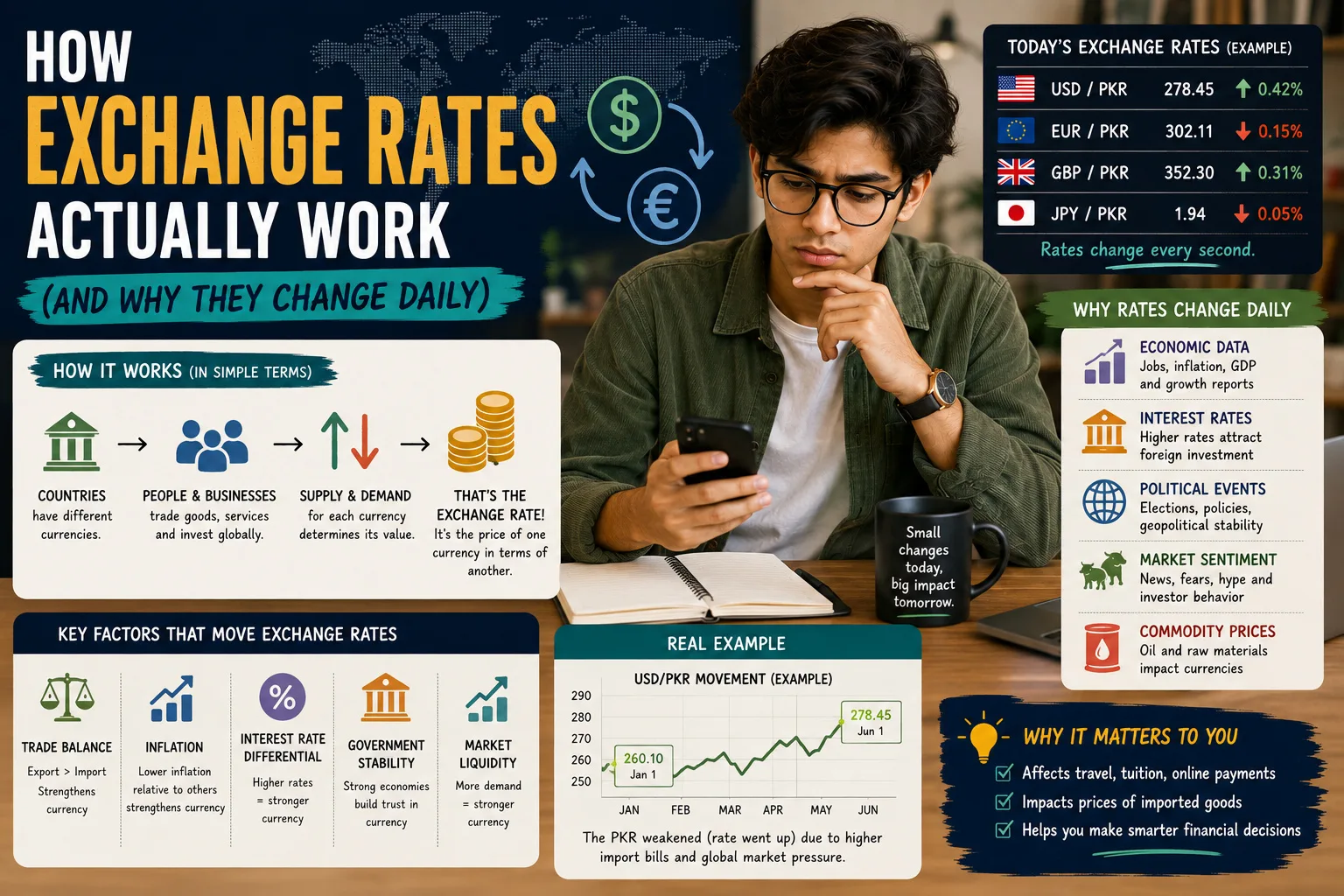
Open a currency app for USD to PKR and you'll usually see two numbers that don't quite match: the rate the app or bank actually gives you, and a slightly better number floating around in the news or on Google. That second number is the mid-market rate — the real, no-markup midpoint between what currency traders are buying and selling at, at that exact moment. Understanding the gap between the two, and what pushes both of them around day to day, saves real money on anything from a holiday budget to a freelancer's monthly invoice. Our currency converter shows both figures side by side.
Spot rate vs mid-market rate vs the rate you actually get
The spot rate is the price for exchanging currency “on the spot” — essentially immediately — as opposed to a rate locked in for a future date. Within the spot market at any instant there are two prices: the bid (what dealers will pay to buy a currency from you) and the ask (what they'll charge to sell it to you). The mid-market rate is simply the midpoint between bid and ask — the fairest single number to quote, and the one financial media usually reports.
No retail provider actually gives you the mid-market rate. Banks, money changers and payment apps all build in a margin, either as a visibly worse exchange rate, an explicit fee, or both. A 2–3% spread is common at banks; some money changers get closer to mid-market; card networks and neobanks vary widely. On a $2,000 currency exchange, the difference between a 1% margin and a 4% margin is $60 — worth comparing before a big transfer.
What actually moves exchange rates
Currency prices are, ultimately, the result of supply and demand for one currency versus another, but a handful of forces do most of the pushing:
- Interest rates: when a country's central bank raises rates, that currency typically becomes more attractive to hold (better returns on deposits and bonds), which tends to push its value up relative to currencies with lower rates.
- Inflation: currencies losing purchasing power quickly at home tend to weaken against currencies with more stable prices, because their real returns are lower once inflation is accounted for.
- Central bank action and expectations: markets move on what a central bank is expected to do next, not just what it has already done — a rate-cut rumor can move a currency before any actual cut happens.
- Trade and capital flows: countries that export more than they import tend to see steady demand for their currency; large foreign investment inflows or outflows can swing rates too.
- Sentiment and risk appetite: in uncertain times, money often flows toward currencies seen as “safe havens,” regardless of that country's own economic story that particular week.
A worked example
Say the mid-market rate is 1 USD = 278.50 PKR. A bank offering you 271.00 PKR per dollar on a $1,000 transfer is applying roughly a 2.7% margin — you'd receive 271,000 PKR instead of the 278,500 PKR a zero-margin exchange would give, a gap of 7,500 PKR. A money changer quoting 276.80 is only charging about a 0.6% margin on the same transaction. Multiply that gap across a semester's tuition transfer or a freelancer's monthly USD income and the provider you choose matters as much as the headline rate that day.
Why rates move even within one day
Major currency pairs trade around the clock across global markets, so rates shift constantly — not just from economic news, but from routine order flow, month-end corporate payments, and algorithmic trading reacting to tiny price differences in milliseconds. For everyday purposes this means: don't fixate on getting the exact bottom of a rate's daily range, but do compare providers before a large transfer, since the provider-margin gap is usually far larger than the day's natural rate movement.
Practical takeaways
- Always check the mid-market rate first so you know what “fair” looks like, then compare it against what your bank or app actually offers.
- Compare total cost, not just the rate — some providers advertise a good rate but add a flat transfer fee on top.
- For recurring transfers (like freelance income or remittances), a 1–2% saved margin adds up fast — it's worth shopping around periodically rather than always using the same app out of habit.
Run any pair through the currency converter to see the current conversion, and use the VAT calculator if you're also working out tax on a cross-border purchase.
Exchange rates move constantly and provider margins change without notice — treat the numbers above as illustrative, not a live quote, and always check the current rate before moving real money.
Frequently asked questions
What's the difference between the mid-market rate and the rate my bank gives me?The mid-market rate is the pure midpoint between what currency traders are buying and selling at, with no markup. Banks and apps add their own margin on top, so the rate you're actually offered is always a little worse than the mid-market figure — the size of that gap is the provider's profit.
Currencies trade continuously across global markets, so rates shift with interest rate news, inflation data, central bank statements, trade flows and simple shifts in trader sentiment — sometimes several times an hour, even without any single big headline.
Airport kiosks are almost always the worst value because of a captive audience. Banks and dedicated money-transfer apps are usually cheaper, but margins vary a lot between them — compare the total amount you'll actually receive, not just the advertised rate.
Yes — a freelancer converting USD income to local currency is exposed to both the exchange rate on the day of conversion and the provider's margin. Comparing providers periodically, and converting on a schedule rather than reactively, can meaningfully change take-home income over a year.
These just describe a currency's value relative to another currency at a point in time. A weaker local currency makes imports and foreign travel more expensive but can make local exports more competitive — the effect on any individual depends heavily on what they buy, sell or get paid in.
Related tools
- FXCurrency Converter
Convert between currencies using a clear, up-to-date rate.
- VATVAT Calculator
Add or remove VAT at any rate — net, tax and gross instantly.
- H⇄SHourly to Salary Converter
Convert an hourly rate to monthly and yearly pay — and back.
- %Percentage Calculator
Percent of a number, percentage share, and increase or decrease.