 Genzee
Is Buy Now Pay Later Worth It? The Real Cost of Pay-in-4
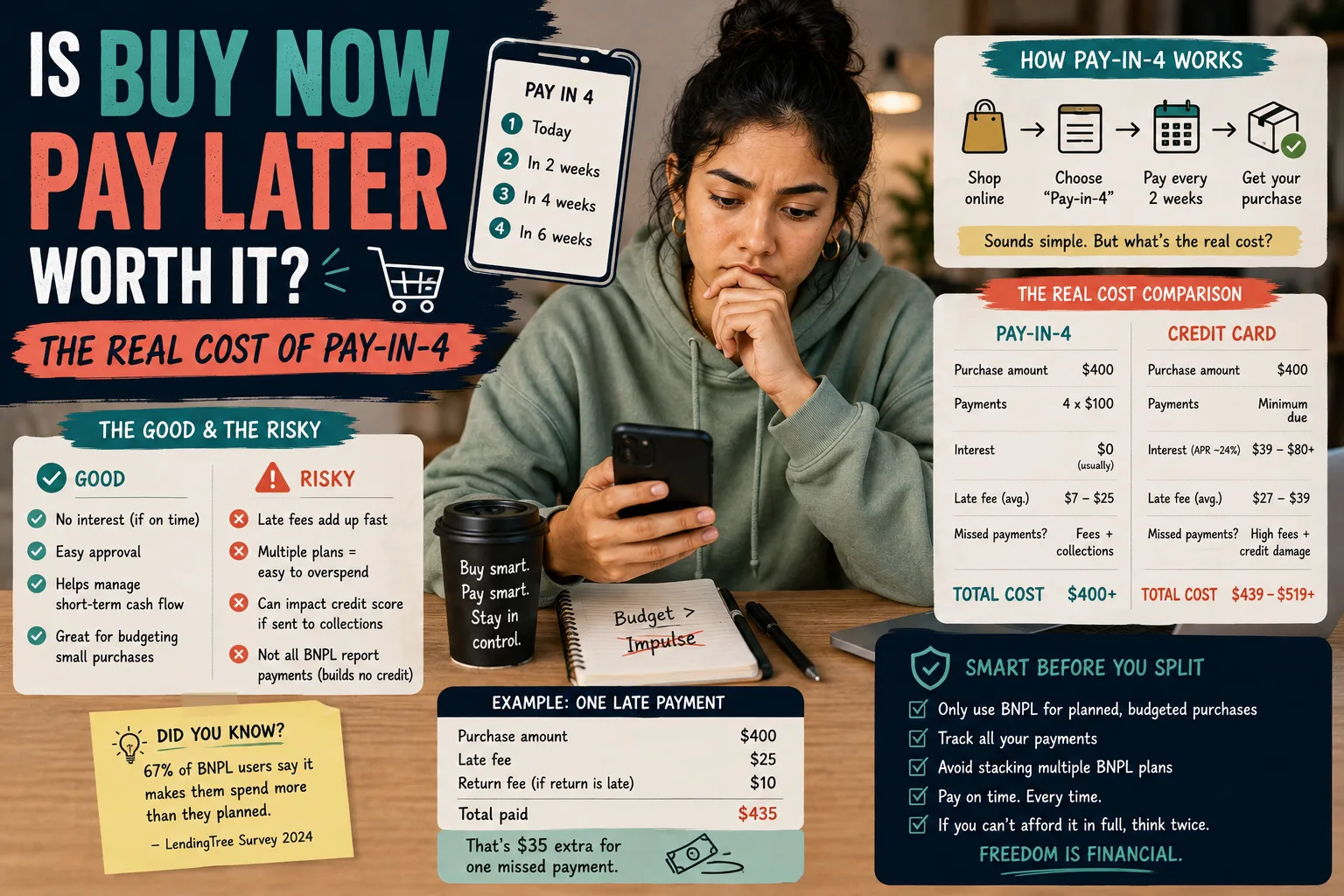
Buy Now Pay Later — usually structured as “Pay-in-4,” splitting a purchase into four equal installments every two weeks with no interest — has become the default checkout option at a huge share of online stores. It's easy to use, feels harmless because there's often no interest charged, and takes seconds to sign up for. It's also easy to stack, which is exactly where it stops being harmless. Here's what's actually happening behind the “four easy payments” button.
How Pay-in-4 actually works
A $200 purchase becomes four payments of $50: one today, then one every two weeks for six weeks. Most providers don't run a hard credit check for Pay-in-4 (a soft check is common), approval is near-instant, and if you pay on schedule you're charged nothing beyond the item's price. That “free if you pay on time” structure is the entire pitch — and for a single, planned purchase within budget, it genuinely can be a zero-cost way to spread a payment.
The risk shows up in two places: what happens when a payment is missed, and what happens when several BNPL plans are running at once across different apps, each quietly withdrawing money from the same bank account every two weeks.
What late payments actually cost
Fee structures differ by provider and have changed as regulators pay closer attention, but real examples are instructive. Afterpay caps late fees at 25% of the original order value, or a flat amount around $8, whichever is lower — so a missed payment on a $200 order costs meaningfully less than 25% of $200 in practice, but it's still a real charge on top of the price you already agreed to pay. Klarna generally does not charge late fees on its Pay-in-4 plans in the US, but a missed payment isn't consequence-free: Klarna can restrict your account from making further BNPL purchases and will keep trying to collect the amount owed. The details vary by provider and country, so always check the specific plan's terms before checking out — this is exactly the kind of fine print that changes.
The credit-reporting shift you should know about
For years, BNPL's main selling point over a credit card was that it mostly didn't touch your credit report. That's changing. Starting around 2025, major providers — including Affirm and Klarna — began reporting Pay-in-4 activity to credit bureaus in various markets, meaning on-time payments can start building credit history, but missed payments can now start showing up the same way a missed credit card payment would. This is a meaningful shift: BNPL is moving from a low-stakes, invisible-to-lenders product toward something that behaves more like a small short-term loan on your credit file. Check what your specific provider currently reports — practices are still evolving and differ by country.
Why it's easy to overspend on BNPL
The behavioral trap isn't any single Pay-in-4 plan — it's running several at once. Four $50 payments feel smaller than one $200 payment, so it's easy to say yes to a purchase you'd hesitate over if paying the full price upfront. Do that across three or four purchases in a month and you can end up with six or eight installments landing in the same two-week window, none of which felt like “debt” at the moment of checkout. The BNPL cost calculator lays out exactly what a plan will cost — including any fees — against simply paying in full.
When BNPL is fine, and when it's a warning sign
- Reasonably fine: one planned purchase, within budget, where the installment amount is already accounted for in the next six weeks of spending.
- Worth pausing on: using BNPL because the full price feels too high right now — that's usually a sign the purchase itself needs to wait, not that it needs splitting.
- Warning sign: juggling more than one or two active BNPL plans at a time, or using a new BNPL purchase to cover a payment on an older one.
The simplest test: if you wouldn't put the purchase on a credit card and pay it off in six weeks, splitting it into four parts doesn't change the underlying affordability math — it just changes how it feels.
This is general information on how BNPL products typically work, not financial advice — fees, credit-reporting practices and terms vary by provider and change often, so check your provider's current terms before using Pay-in-4.
Frequently asked questions
Does Buy Now Pay Later charge interest?Standard Pay-in-4 plans typically don't charge interest if you pay on schedule — the cost to the provider is usually recovered from the merchant instead. Longer-term BNPL plans (paid monthly over several months) often do charge interest, so always check which type of plan you're being offered.
It can, increasingly. Since 2025 several major providers have started reporting Pay-in-4 activity — including missed payments — to credit bureaus in some markets. Even where a single provider doesn't report, missed payments can still be sent to collections, which does affect credit.
It depends on the provider. Some charge a capped late fee (for example, Afterpay caps fees around 25% of the order value or roughly $8, whichever is lower); others, like Klarna's US Pay-in-4, typically don't charge a late fee but may restrict your account from further purchases until the balance is settled.
It's the most common way BNPL becomes a problem. Each individual plan looks small, but several running together create a cluster of payments every two weeks that's easy to lose track of, especially since they often aren't all in one app.
Not inherently — a well-managed Pay-in-4 plan paid on time can be genuinely interest-free, which beats carrying a credit card balance. The risk profile is different, not simply worse: BNPL is easier to stack across multiple purchases and providers, which is where the real danger lies.
Related tools
- BNPLBNPL Cost Calculator
See the real cost of a Pay-in-4 plan versus paying upfront.
- EMILoan / EMI Calculator
Work out your monthly instalment, total interest and full amortization schedule.
- SGSavings Goal Calculator
How long to reach a savings target with monthly deposits.
- %Percentage Calculator
Percent of a number, percentage share, and increase or decrease.