 Genzee
BMI Guide: What Your Body Mass Index Tells You — and What It Doesn't
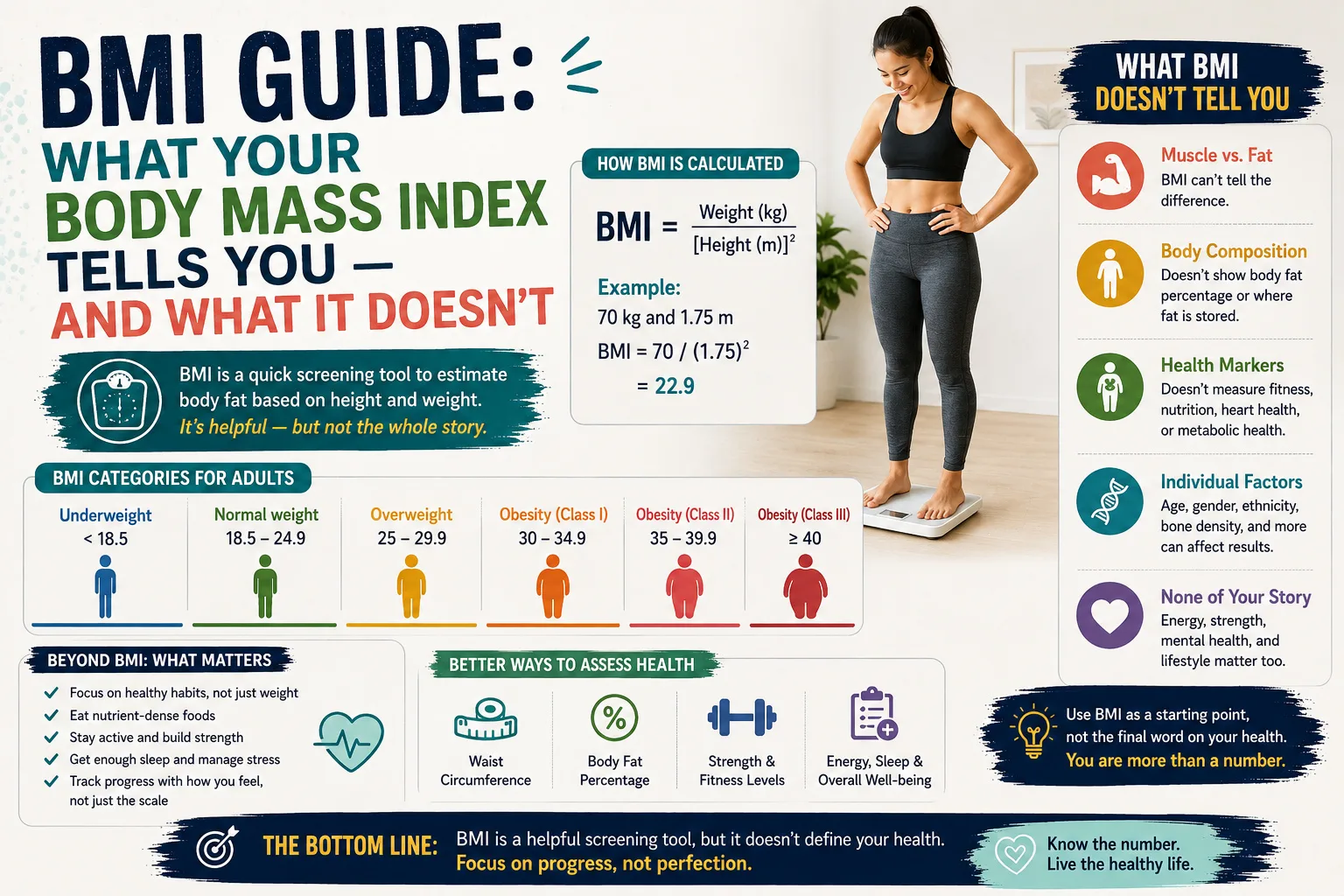
Body Mass Index is the world's most used — and most argued-about — health number. Doctors screen with it, insurers price with it, and fitness apps nag with it, while critics point out that it can label a fit athlete "overweight". Both sides are partly right. This guide explains what BMI actually measures, what the categories mean (especially for South Asians), where the number misleads, and what to check alongside it. Get your own figure first with the free BMI calculator — it takes ten seconds.
What BMI is
BMI relates weight to height with one formula:
A 70 kg person at 1.75 m has BMI 70 ÷ 3.0625 = 22.9. Devised by the Belgian statistician Adolphe Quetelet in the 1830s to describe populations, it was never designed as an individual diagnostic — a caveat worth holding onto for the rest of this article.
The WHO categories
Population studies consistently link higher BMI with greater risk of type 2 diabetes, high blood pressure, heart disease, several cancers and joint problems — and low BMI with malnutrition, weakened immunity and osteoporosis risk. As a screening signal across millions of people, BMI works.
The South Asian adjustment
Here is the part most relevant to readers in Pakistan: research shows South Asians tend to carry more body fat — particularly visceral, around-the-organs fat — at the same BMI as Europeans, and develop diabetes and heart disease at lower BMIs. The WHO has therefore suggested lower action points for Asian populations: risk rises from BMI 23, and is high from 27.5. If your BMI is 24 and the standard chart says "normal", the South Asian evidence says "worth a conversation with your doctor", especially with family history of diabetes.
Where BMI misleads
- Muscle vs fat. Muscle is denser than fat. A rugby player and a sedentary office worker can share a BMI of 27 with completely different health outlooks. BMI cannot tell them apart.
- Fat location. Abdominal (visceral) fat drives metabolic risk far more than fat on hips and thighs, and BMI is blind to the difference.
- Age. Older adults lose muscle; a "normal" BMI can hide low muscle and excess fat. Slightly higher BMI in the elderly is not automatically worse.
- Children and pregnancy. Adult cut-offs simply don't apply — children need age-sex percentile charts, and pregnancy weight gain is expected and healthy.
Better together: companion measures
Waist circumference is the cheapest upgrade: measure at the navel, relaxed. Widely used action points for South Asians are 90 cm (35.4") for men and 80 cm (31.5") for women. Waist-to-height ratio is even simpler — keep your waist under half your height. Blood pressure, fasting glucose and lipid tests complete the picture; plenty of "normal BMI" metabolic problems only show up in blood work.
A realistic example
Imran, 38, is 1.70 m and 78 kg: BMI 27.0 — "overweight" on the standard chart, and firmly in the high-risk band on the South Asian scale. The calculator shows his healthy range as 53.5–71.9 kg. Rather than a crash diet, he targets 0.5 kg a week: walking 30 minutes daily, halving sugary drinks, and eating roti and rice in measured portions. Six months later he is at 71 kg (BMI 24.6), his waist is down 7 cm, and his fasting glucose has normalised. The BMI number didn't do that — but it started the process.
The sensible way to use BMI
Treat BMI like a smoke alarm, not a fire inspector: cheap, always available, occasionally beeping for the wrong reason, and never to be ignored outright. Check it a few times a year (weight, unlike height, drifts), interpret it with the South Asian cut-offs if they apply to you, pair it with a waist measurement, and let a doctor — not a website, including this one — turn numbers into decisions. Our BMI calculator and age calculator are good record-keeping companions for exactly that.
Tracking BMI usefully over time
A single BMI reading is a snapshot; the value is in the trend. Weigh under consistent conditions — same scale, morning, before breakfast — and re-check BMI monthly rather than daily, because day-to-day weight noise (water, salt, hormones) swings readings without any change in body fat. Pair every check with a waist measurement at the navel: BMI holding steady while the waist shrinks usually means fat lost and muscle gained — a win the scale hides — while a stable BMI with a growing waist is the reverse warning. Keep a simple log (date, weight, BMI, waist); three months of entries tells you more than any chart on the internet.
Set targets in stages rather than leaping for the "normal" band: if your BMI is 31, a first target of 28 — roughly 8% of body weight — already delivers most of the near-term health improvement (blood pressure, sugar control, joint load), and staged targets survive motivation dips that a distant finish line doesn't. The calorie calculator converts each stage into a daily eating plan, and the deficit guide covers the execution. Finally, re-measure height every few years past fifty — height loss silently inflates BMI, and a doctor should interpret readings alongside your full picture, not the number alone.