 Genzee
What a Weaker Rupee Actually Costs You
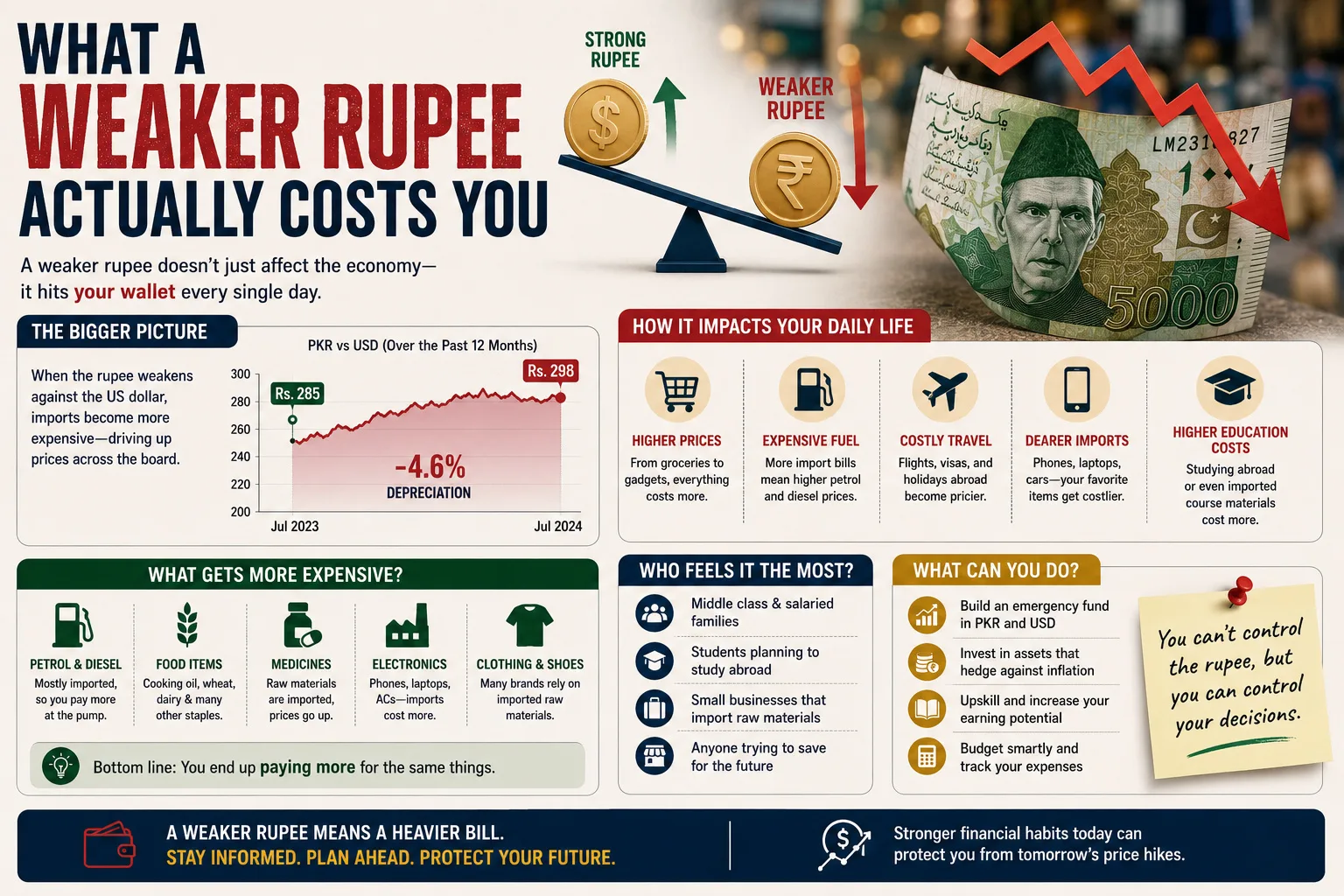
"The rupee fell 2% against the dollar this month" is the kind of headline that's easy to read past — a small-sounding percentage, no obvious connection to daily life. Translated into actual prices, currency depreciation is one of the more direct ways a macroeconomic shift reaches into an ordinary household budget.
Why so much of what Pakistan buys is priced in dollars
Pakistan imports the large majority of its crude oil, along with significant machinery, raw materials for local manufacturing, and many finished goods — nearly all priced internationally in US dollars regardless of where they're ultimately sold. When the rupee weakens against the dollar, the rupee cost of every one of those imports rises directly, with no other factor needing to change.
The transmission from currency to your bill
A weaker rupee raises the landed cost of imported fuel, which raises transport and production costs across the economy, which raises the price of many locally produced goods that depend on that fuel or on imported inputs — a chain reaction that spreads well beyond obviously imported items. This is one of the primary channels through which currency depreciation shows up as broad inflation, not just higher prices on a narrow list of imported goods.
A concrete way to see the cost
Take an imported item priced at $1,000. At a rate of 250 PKR per dollar, that's 250,000 rupees. At 280 PKR per dollar — a roughly 12% depreciation — the same item costs 280,000 rupees: an extra 30,000 rupees for an item whose actual foreign price never changed at all. Running real numbers through a depreciation-impact calculation turns an abstract percentage into a number that's much easier to actually reason about.
Who feels this most
Rupee depreciation affects everyone who buys imported or import-dependent goods, but it hits hardest for anyone with dollar-denominated obligations — overseas tuition fees, import-dependent small businesses, and anyone repaying foreign-currency debt — where the rupee cost of a fixed dollar obligation rises directly with the exchange rate, regardless of whether their own income rose at all.
The other side: who benefits
A weaker rupee isn't purely bad news for everyone — exporters earning dollars and converting them to rupees receive more rupees for the same dollar sale, and overseas Pakistanis sending remittances home see those dollars convert into more rupees too. Currency depreciation redistributes real costs and benefits across different groups rather than uniformly making the country poorer, even though the immediate headline usually frames it as a straightforward negative.