 Genzee
What Inflation Really Does to Money You Are Not Investing
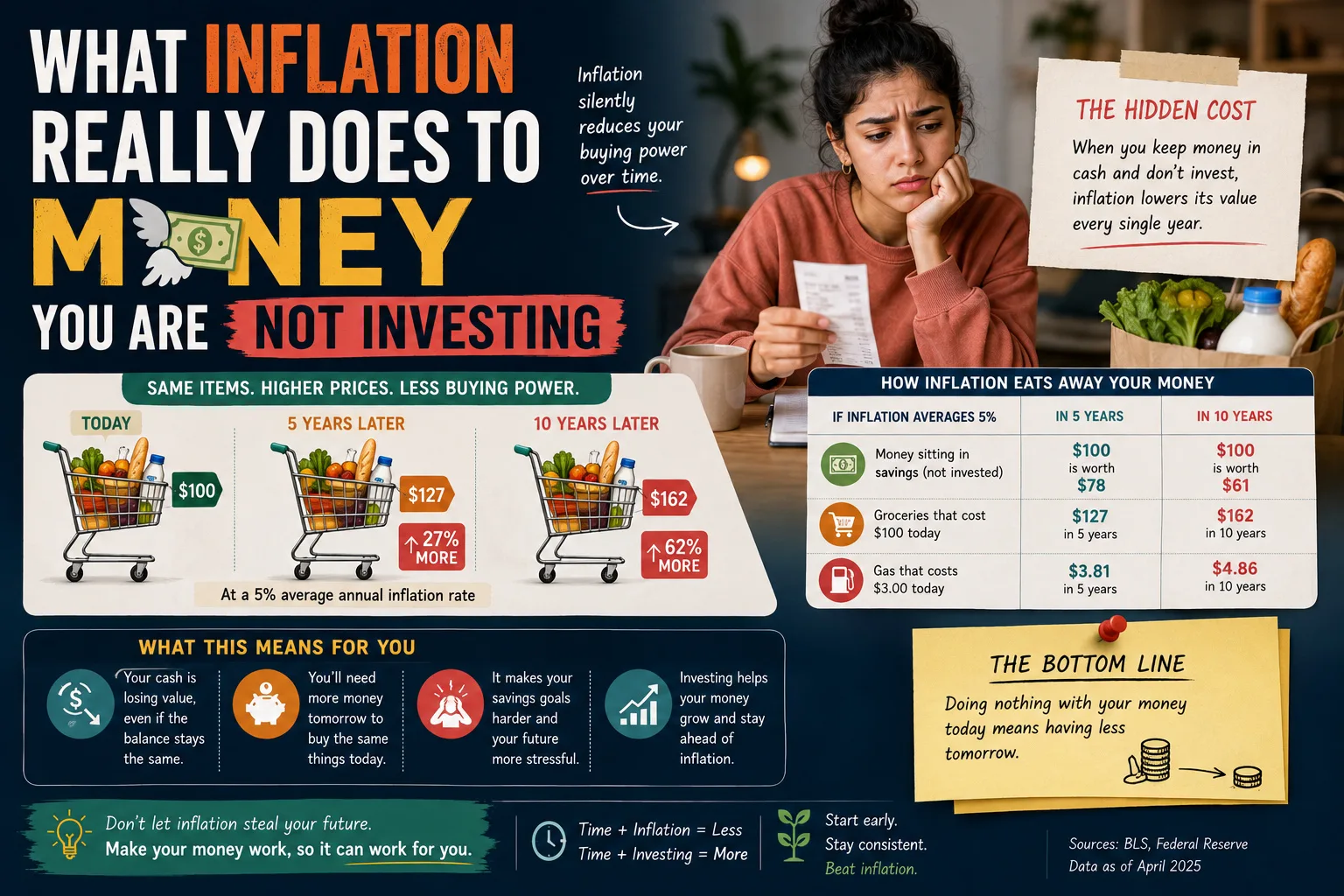
Cash in a savings account feels like the safest possible place for money — nothing can make the number go down. But "the number" and "what the number can actually buy" are two different things, and inflation quietly separates them every single year.
The mechanism, in plain terms
Inflation means the average price of goods and services rises over time. If prices rise 8% in a year and your savings earned nothing, the same amount of money buys roughly 8% less than it did twelve months earlier. The account balance is unchanged — the purchasing power behind it has shrunk.
What this looks like over a longer horizon
At 8% average annual inflation, 100,000 today would only have the purchasing power of roughly 46,300 in ten years' time, measured in today's terms. That is not a hypothetical worst case — it is simple compounding working in reverse against a static sum of money, the same math that makes investment growth powerful, just running the opposite direction.
Why "safe" cash still needs a strategy
The point isn't that holding cash is a mistake — an emergency fund, for instance, correctly prioritizes guaranteed availability over growth. The point is that any money held in cash for the long term needs to at least earn a return matching inflation just to tread water in real terms; anything less is a quiet, guaranteed real loss, even though it never shows up as a negative number on a statement.
The practical takeaway
Short-term savings and emergency funds belong in cash regardless of inflation, because their job is availability, not growth. Money that won't be needed for years is a different case — leaving it in a zero or low-interest account isn't the "safe" choice it feels like; it is a specific bet that inflation will stay low, which historically has not always been a safe bet to make.
Nominal returns versus real returns
An investment or savings account advertising a "10% return" sounds identical whether inflation that year is 2% or 12% — but the real, inflation-adjusted return is wildly different in each case: roughly 8% in the first scenario, close to flat in the second. Any time a return is quoted, it's worth asking whether it's a nominal figure (before inflation) or a real one (after inflation), since headline "growth" that barely outpaces inflation is closer to standing still than it appears.
Inflation does not hit every price equally
A single average inflation rate is useful as a planning shortcut, but it hides real variation — historically, costs like education, healthcare and housing have often risen faster than the broad average in many economies, while some consumer electronics have gotten cheaper over the same period. Anyone planning specifically for a big future cost tied to one of the faster-rising categories should treat the general inflation rate as a floor for their planning assumption, not a precise estimate for that specific expense.