 Genzee
What Does the State Bank of Pakistan Actually Do? A Plain-English Guide
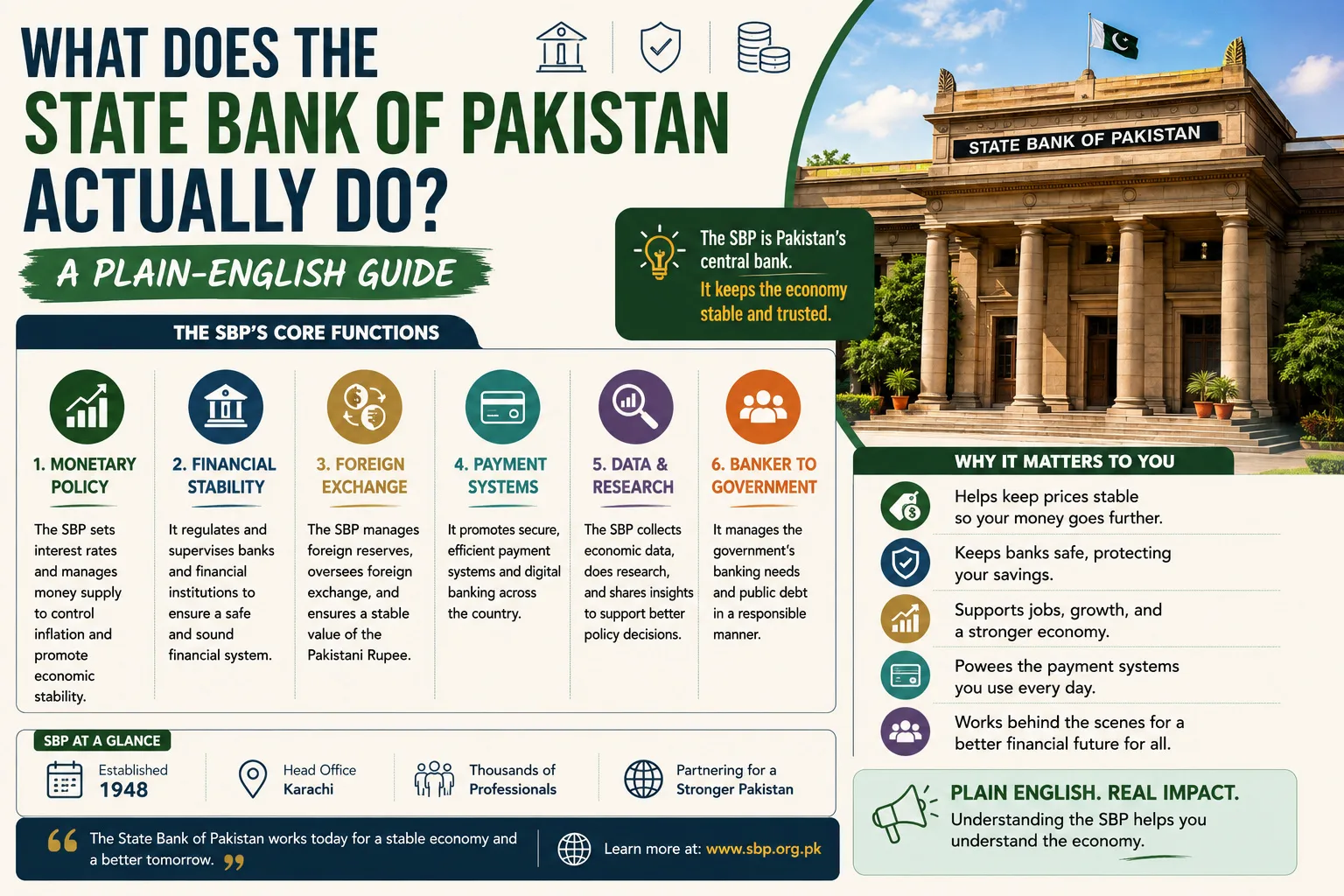
The State Bank of Pakistan appears in the news constantly — holding rates, managing reserves, issuing new rules for banks — but what does the country's central bank actually do, and why does it matter to someone who has never set foot inside a bank branch?
Setting monetary policy
The SBP's Monetary Policy Committee meets on a scheduled basis to set the policy interest rate — the rate that influences borrowing costs throughout the economy, from mortgages to business loans to credit cards. Raising the rate generally cools inflation by making borrowing more expensive and saving more attractive; cutting it generally stimulates borrowing and spending. This single number cascades through the entire financial system.
Managing the currency and reserves
The SBP holds Pakistan's foreign exchange reserves and can intervene in the currency market to smooth excessive volatility, though the rupee trades under a broadly market-determined system rather than a fixed peg. Reserve levels, reported weekly, are watched as a signal of the country's capacity to handle external payment obligations and currency pressure.
Regulating banks
Every commercial bank operating in Pakistan is regulated and supervised by the SBP, which sets capital requirements, conducts inspections, and can intervene when a bank faces serious problems — the layer of oversight that exists specifically to protect depositors and maintain confidence in the banking system as a whole.
The Governor's role
The SBP Governor leads the institution and its Monetary Policy Committee, and is often the public face of major announcements — rate decisions, reserve updates, and broader economic commentary. Governor statements are watched closely by markets and media because they can signal the central bank's thinking ahead of a formal decision, not just report on the past.
Why all of this affects ordinary people
SBP decisions ripple outward in concrete ways: a rate hike raises the cost of a car loan or mortgage but can improve returns on savings accounts and government securities; currency management affects the price of imported goods, from fuel to electronics; bank regulation is what makes it reasonably safe to keep money in a Pakistani bank account in the first place. None of this requires financial expertise to follow — understanding the basic mechanism makes SBP headlines meaningfully more useful than background noise.
Independence from day-to-day government control
Central banks, including the SBP, are generally structured with a degree of operational independence from the government's fiscal decisions specifically so monetary policy can respond to inflation and currency conditions without being driven by short-term political pressure. This separation is a deliberate design choice found in most modern economies, intended to keep interest rate decisions grounded in economic data rather than election cycles.
Where to actually follow SBP announcements
The SBP publishes monetary policy decisions, reserve data, and Governor statements directly on its official website, alongside regular economic bulletins — a more reliable primary source than secondhand summaries, especially around a scheduled policy rate announcement where the exact wording of the accompanying statement often matters as much as the rate decision itself.