 Genzee
VAT vs Sales Tax: What's the Difference and How Is Each Calculated?
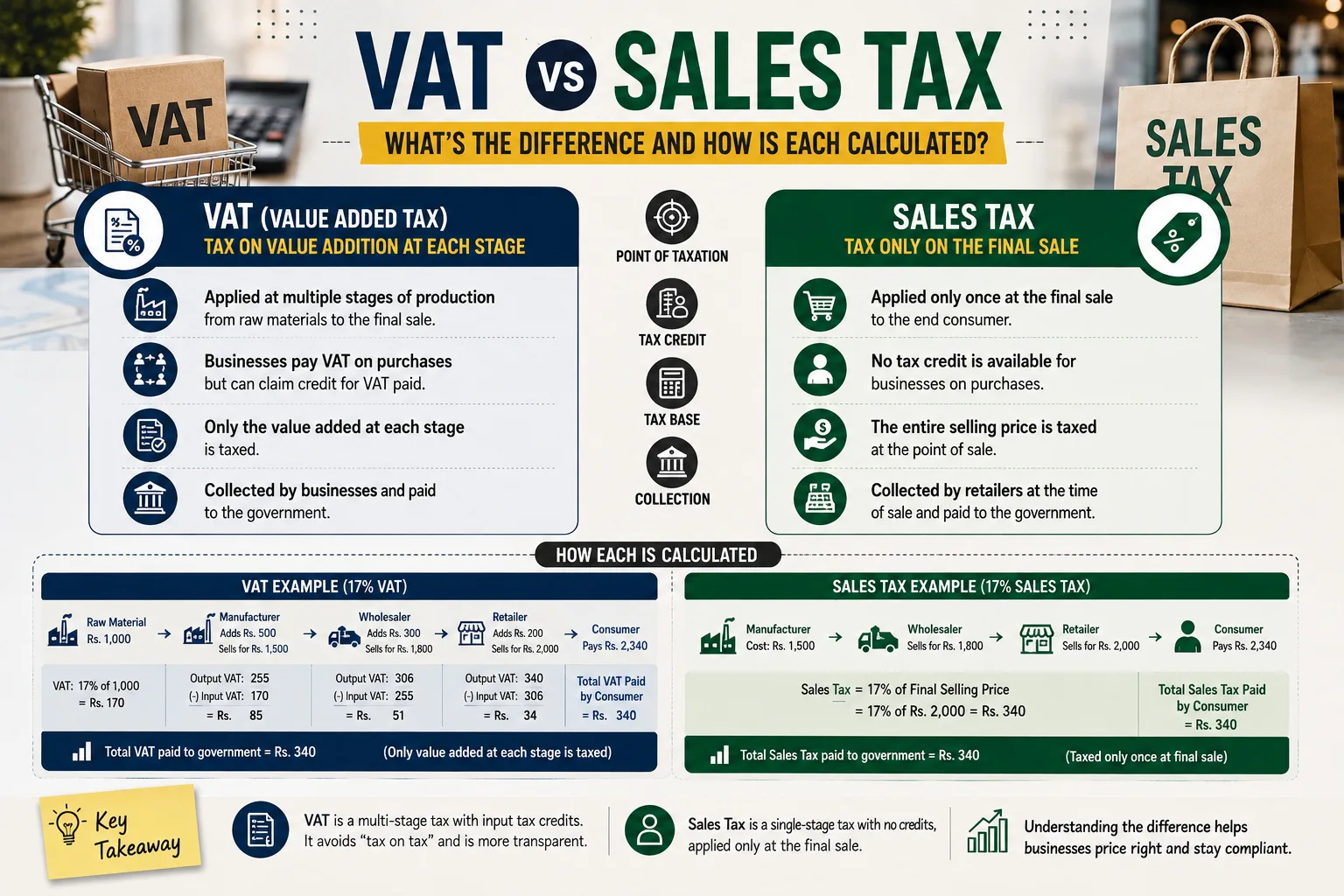
Walk out of a shop almost anywhere in the world and your receipt carries an extra percentage — VAT in the UK and Europe, GST in Pakistan and India, "sales tax" in the United States. The three names get used interchangeably in conversation, and for a shopper the effect feels identical: the price grows. But the systems behind them differ in ways that matter to anyone running a business, invoicing foreign clients, or just trying to understand a receipt. Here is the whole picture in plain language.
Sales tax: charged once, at the end
A classic retail sales tax — the American model — is charged only at the final sale to the consumer. The factory sells to the wholesaler tax-free, the wholesaler to the retailer tax-free, and only when you buy the item at the counter does the state's percentage get added. One tax, one collection point. Its weakness is enforcement: the entire tax depends on the last seller honestly charging and remitting it.
VAT: collected in slices along the chain
Value Added Tax collects the same total differently: every business in the chain charges VAT on its sales and reclaims the VAT it paid on its purchases, remitting only the difference — the tax on the value it added. A cloth mill buys cotton (paying VAT), weaves fabric and sells it with VAT charged; it remits the difference. The garment factory does the same, and so on to the shop. The consumer still bears the full amount in the final price, but the state collects it in instalments, with every invoice creating a paper trail that makes evasion harder. This is why over 170 countries use VAT-style systems.
Where Pakistan's GST fits
Pakistan's General Sales Tax on goods — 18% standard at the time of writing — is, despite its name, a VAT-style tax: registered businesses charge output tax, claim input tax, and remit the net through monthly returns to FBR. Services are taxed separately by the provinces (Sindh, Punjab, KP and Balochistan each run their own services tax at typically 13–16%). So a Pakistani invoice can involve federal GST on goods and provincial tax on services — one reason small businesses are wise to get the categorisation right early.
The arithmetic (identical for both)
Whatever the system, the sums on a single price are the same two operations:
Extracting tax: price = total ÷ (1 + rate ÷ 100)
The second one is where mistakes live. A receipt total of PKR 5,900 at 18% does not contain 18% × 5,900 = 1,062 of tax. The pre-tax price is 5,900 ÷ 1.18 = 5,000, so the tax is 900. Our sales tax calculator and VAT calculator both do the extraction correctly in either direction.
A worked chain example
Follow a shirt through a VAT-style 18% chain. The mill sells fabric to a factory for PKR 1,000 + 180 tax. The factory turns it into a shirt and sells it to a shop for PKR 2,000 + 360 tax, but reclaims the 180 it paid — net remittance 180. The shop sells the shirt to you for PKR 3,000 + 540 tax, reclaiming its 360 — net remittance 180. Total collected by the state: 180 + 180 + 180 = 540, exactly 18% of the final 3,000 price, and exactly what you paid at the till. The chain changed who wrote the cheques, not the burden.
What it means in practice
- Shoppers: the difference is academic — compare final, tax-inclusive prices.
- Small businesses: registration thresholds decide whether you charge tax at all; once registered, keeping purchase invoices is literally money (input tax you can reclaim).
- Freelancers with foreign clients: whether you must charge your client's country's VAT depends on place-of-supply rules — many B2B services "reverse charge" so the client accounts for it. When in doubt, invoice net and state the reverse-charge note; a tax adviser can confirm your case.
- Everyone reading receipts: tax-inclusive is the norm on Pakistani retail receipts; business quotations are often ex-tax. Ask which one you're looking at before comparing prices.
The practical toolkit: our GST calculator (preset to Pakistan's 18%), the VAT calculator for any international rate, and the invoice generator that applies your chosen rate to a professional invoice automatically. Between the three, the percentage on the receipt should never surprise you again.
A small-business owner's action list
If you sell anything in Pakistan, the tax-mechanics translate into four concrete habits. First, know your registration position: GST registration is triggered by turnover thresholds and sector rules; selling under the threshold means charging no GST, while crossing it unregistered invites penalties plus back-tax. Check your position annually as revenue grows. Second, keep every purchase invoice: for registered businesses these are input-tax claims — literally cash — and even unregistered shops need them to know true costs for margin pricing. Third, quote prices unambiguously: retail customers expect tax-inclusive figures, business buyers expect ex-tax quotes; stating which one you mean ("Rs 5,900 inc. GST") prevents the argument later, and the calculator converts either way instantly. Fourth, if you sell services, check your province's rules separately — services tax registration, rates and filing run through SRB, PRA, KPRA or BRA rather than FBR, and a Karachi designer with Lahore clients should know which authority's rules bite. None of this needs an accountant to start — a shoebox of invoices and one monthly hour beats most shops' current system — but past GST registration, a professional's fee typically saves more than it costs.