 Genzee
Sale Season Math: How Discounts Really Work (and How to Win)
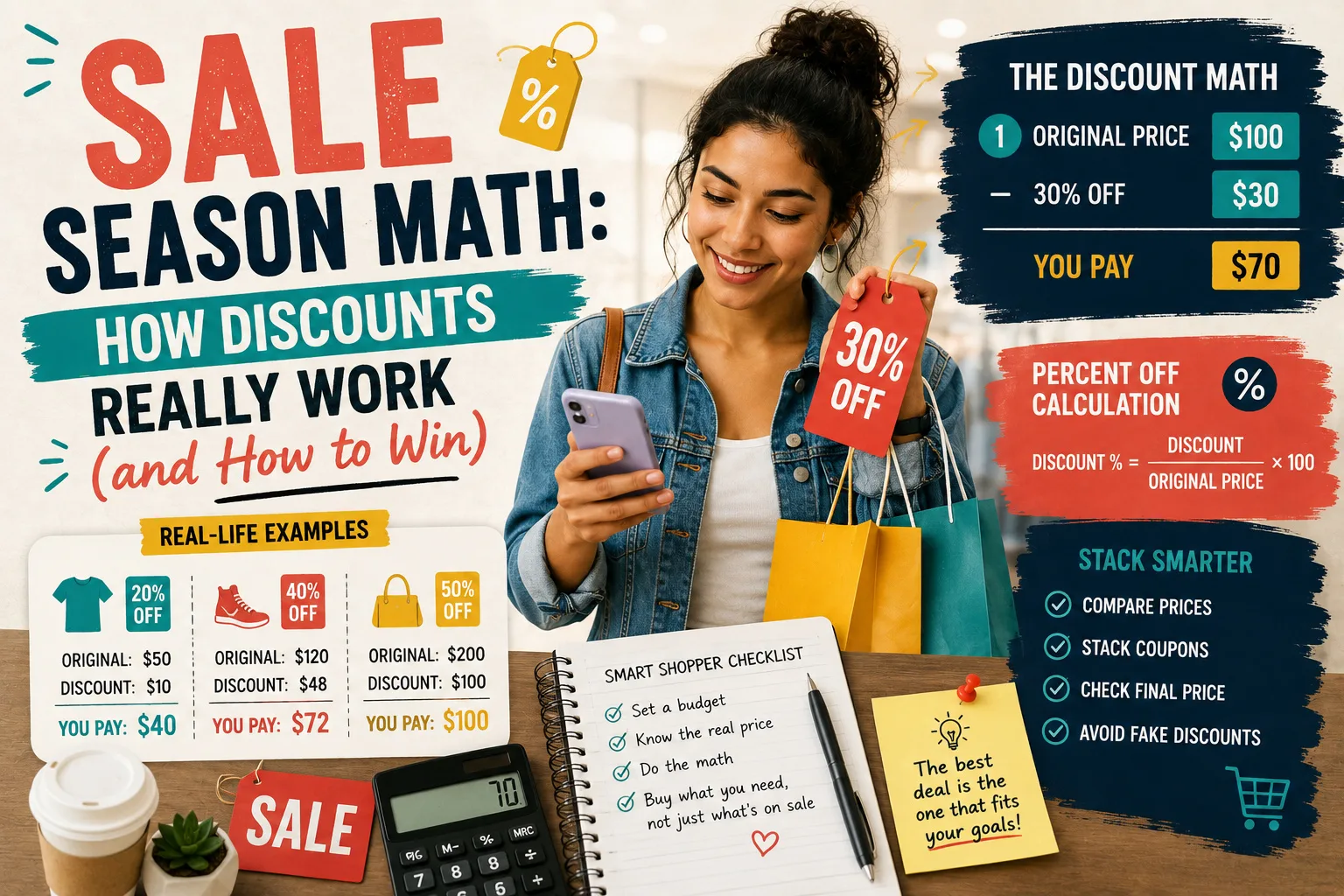
Sale banners are engineered to switch your arithmetic off. "UP TO 70% OFF", "FLAT 40% + EXTRA 20%", "BUY 2 GET 1 FREE" — every formula is chosen because of how it feels, not what it computes to. The shopper who can do four kinds of quick math walks out of sale season genuinely ahead; everyone else mostly buys things they didn't plan to at discounts smaller than advertised. Here are the four, with the traps they defuse.
Trick 1: Stacked discounts don't add
"40% off + extra 20% off" reads as 60%. It isn't. The second discount applies to the already-reduced price:
A PKR 5,000 jacket under that banner costs 2,400 — against the 2,000 your instinct promised. The gap is the point: stacking sounds bigger than it is, which is exactly why retailers stack instead of quoting the honest single number. Rule of thumb: multiply the "keep" fractions, or just punch both stages into the discount calculator.
Trick 2: The inflated "was" price
"Was 8,000, now 4,000!" is only a half-price deal if it was ever really 8,000. Pre-sale price inflation — marking up before marking down — is an old game. The defence is the reverse calculation: ignore the claimed percentage entirely and evaluate the sale price against the market. Check the same or comparable item at two other shops or online; the discount calculator's reverse mode tells you the true percent-off versus any reference price you trust. A "50% off" price that's 10% above a rival's everyday price is a 10% markup wearing a party hat.
Trick 3: Per-unit blindness
"Buy 2 get 1 free" is a 33% discount (you pay for 2 of 3) — not 50%, and only a deal if you wanted three. Bulk packs play the same game: the 5-kg pack at 2,250 versus the 1-kg at 480 is 450/kg versus 480/kg — a real but modest 6% saving that only pays if nothing expires unused. The universal decoder is price-per-unit: divide, compare, decide. Two divisions in the percentage calculator settle any shelf standoff.
Trick 4: The discount that isn't yours
Card-specific discounts, minimum-purchase thresholds ("20% off above 10,000" — inviting you to add 2,000 of filler to save 2,000), and time-pressure countdowns all share one mechanism: making you spend more to "save" more. The arithmetic answer is to price the marginal decision: the filler item costs its full price minus the extra discount it unlocks — if you didn't want it, it's rarely worth it.
The two-question filter that beats every trick
- "Would I buy this at this price with no sale sign?" The saving is fictional if the purchase is; 60% off something unnecessary is 40% wasted, as the old line goes.
- "What is the actual final price — and is it good?" Compute it (stack correctly, add any tax with the sales tax calculator), then compare against the market, not against the tag's fantasy "was" price.
Where the real wins live
- End-of-season on things you'd buy anyway: next winter's jackets in February are genuinely cheap — the retailer's clearance need is real.
- Planned purchases waiting for events: keep a short wishlist with reference prices; when a sale touches an item, you know instantly whether the deal is real. This turns sales from temptation engines into execution windows for your budget's wants bucket.
- Negotiation on top of sales in local markets: a sale price is an opening position in much of Pakistan's retail; polite haggling stacks a real extra percentage where fixed-price chains can't.
None of this requires being joyless — sales are fun, and winning them is more fun. It requires ninety seconds of arithmetic per decision, which is exactly what the discount calculator was built to make effortless. The banner does the shouting; you do the multiplying.
Online sale season: three extra traps
E-commerce adds its own arithmetic games to the classic four. Delivery thresholds: "free delivery above 3,000" tempts a 2,400 cart into 700 of filler to save a 200 fee — pricing the marginal decision (700 spent to save 200) shows the trap instantly. Voucher stacking rules: platform vouchers usually apply after seller discounts and often cap at a maximum rupee value — a "15% off, max 300" voucher on a 5,000 item is a 6% discount wearing a 15% costume; compute the real percentage with the discount calculator's reverse mode before feeling triumphant. Flash-sale price history: the "70% off, 2 hours left" listing may have been the same price last Tuesday; a ten-second search of the item across platforms is the online equivalent of walking to the next shop, and it defeats the countdown clock's entire psychology. The meta-rule across physical and online retail alike: decide the purchase and the acceptable price before the sale exists, then let sales execute your list. Shops optimise for shoppers who decide inside the store; the arithmetic-armed shopper decided at home, calculator in hand, and merely collects.