 Genzee
The Rule of 72: The Quickest Way to Estimate When Your Money Doubles
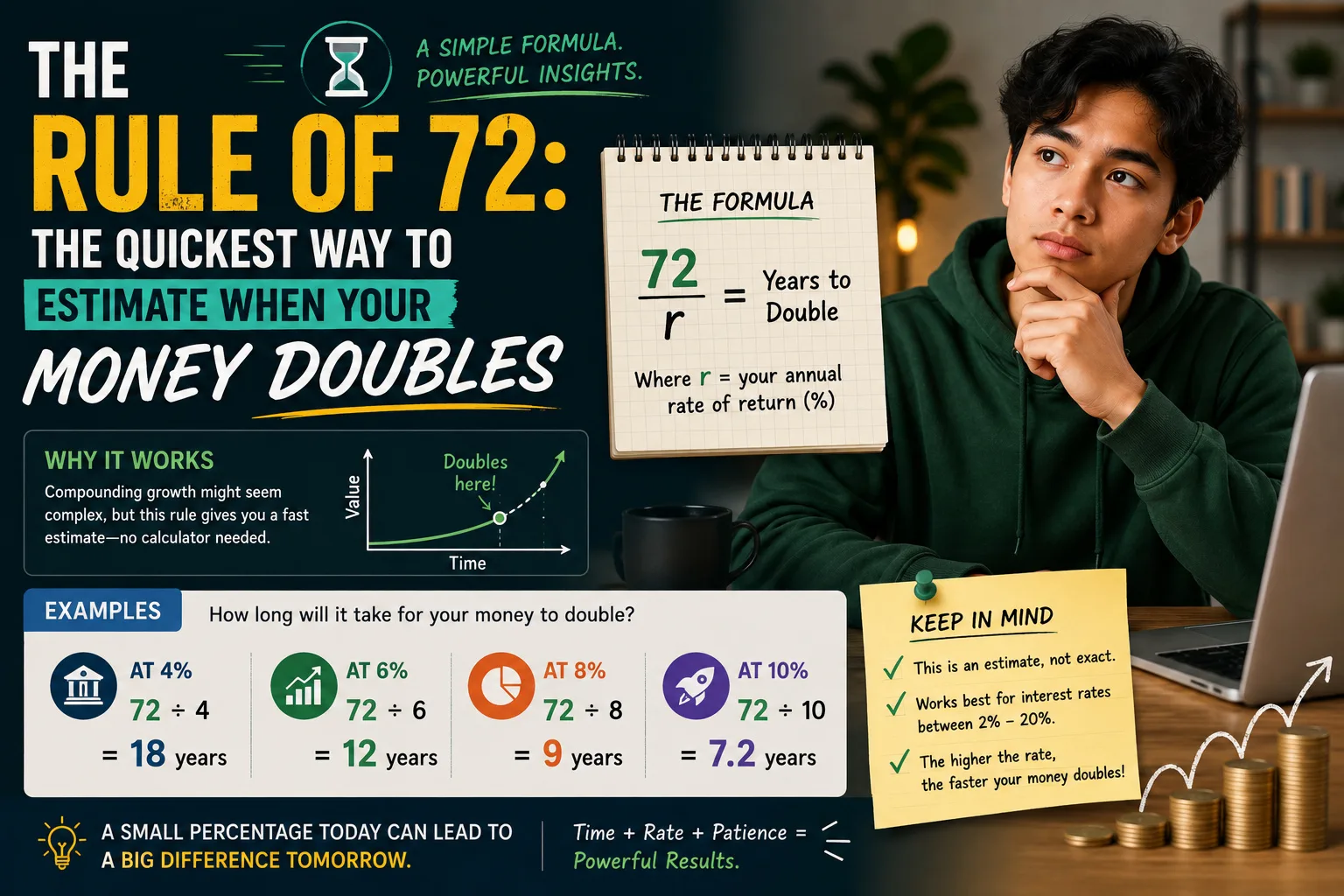
Of all the mental-math shortcuts in personal finance, the Rule of 72 might be the most genuinely useful — a single division that gives a surprisingly accurate answer to one of the most common investing questions: how long until this actually doubles?
The shortcut itself
Divide 72 by an annual return percentage, and the result is roughly the number of years needed for an investment to double in value. At 8% a year, money doubles in about 9 years. At 12%, about 6 years. At 6%, about 12 years — the same relationship, just running in the other direction.
Why it actually works
The true formula for doubling time under compound growth involves natural logarithms — not something anyone does in their head. But across the range of return rates most people actually encounter, roughly 6% to 15%, the logarithmic curve happens to be closely approximated by a simple 72-divided-by-rate calculation. The number 72 is also convenient because it divides evenly by many small numbers (2, 3, 4, 6, 8, 9, 12), making the mental math genuinely easy to do without a calculator.
Where it starts to drift
At very low rates (under 4%) or very high rates (above 20%), the Rule of 72 estimate diverges more noticeably from the exact answer — still in the right ballpark, but no longer precise enough for anything beyond a rough sense of scale. For genuinely low or high rates, running the exact compound growth math is worth the extra step.
Using it to compare options quickly
The real value of the Rule of 72 shows up in comparison, not isolation — quickly sanity-checking that a 10% return doubles money notably faster than a 5% return (7.2 years versus 14.4 years) makes the practical difference between return rates concrete in a way that abstract percentages alone don't. It's a tool for building fast intuition, meant to be followed up with precise numbers before any real decision.
It works in reverse too
The same shortcut applies to anything that grows or shrinks by a consistent percentage rate — inflation eroding purchasing power, debt compounding unpaid interest, or a business metric growing steadily. Divide 72 by an inflation rate to estimate how long until prices double; divide it by a credit card's interest rate to see how fast an unpaid balance could grow if left completely untouched. The math is identical regardless of what's actually growing.
Variations worth knowing
Some use the "Rule of 70" instead, which is marginally more accurate at lower growth rates but divides less evenly by common numbers, making the mental math slightly harder. Others use "Rule of 69.3" for the mathematically precise version at continuous compounding — overkill for a quick mental estimate, but worth knowing exists if a specific field of finance references it under a different name.
A habit worth building
Applying the Rule of 72 casually — to a savings account rate, an investment return, a country's reported inflation figure — turns abstract percentages encountered in everyday reading into a concrete sense of timescale almost automatically. It's one of the few pieces of financial mental math that pays for the small effort of memorizing it many times over.