 Genzee
Rent vs Buy in 2026: The Real Math Behind the Decision
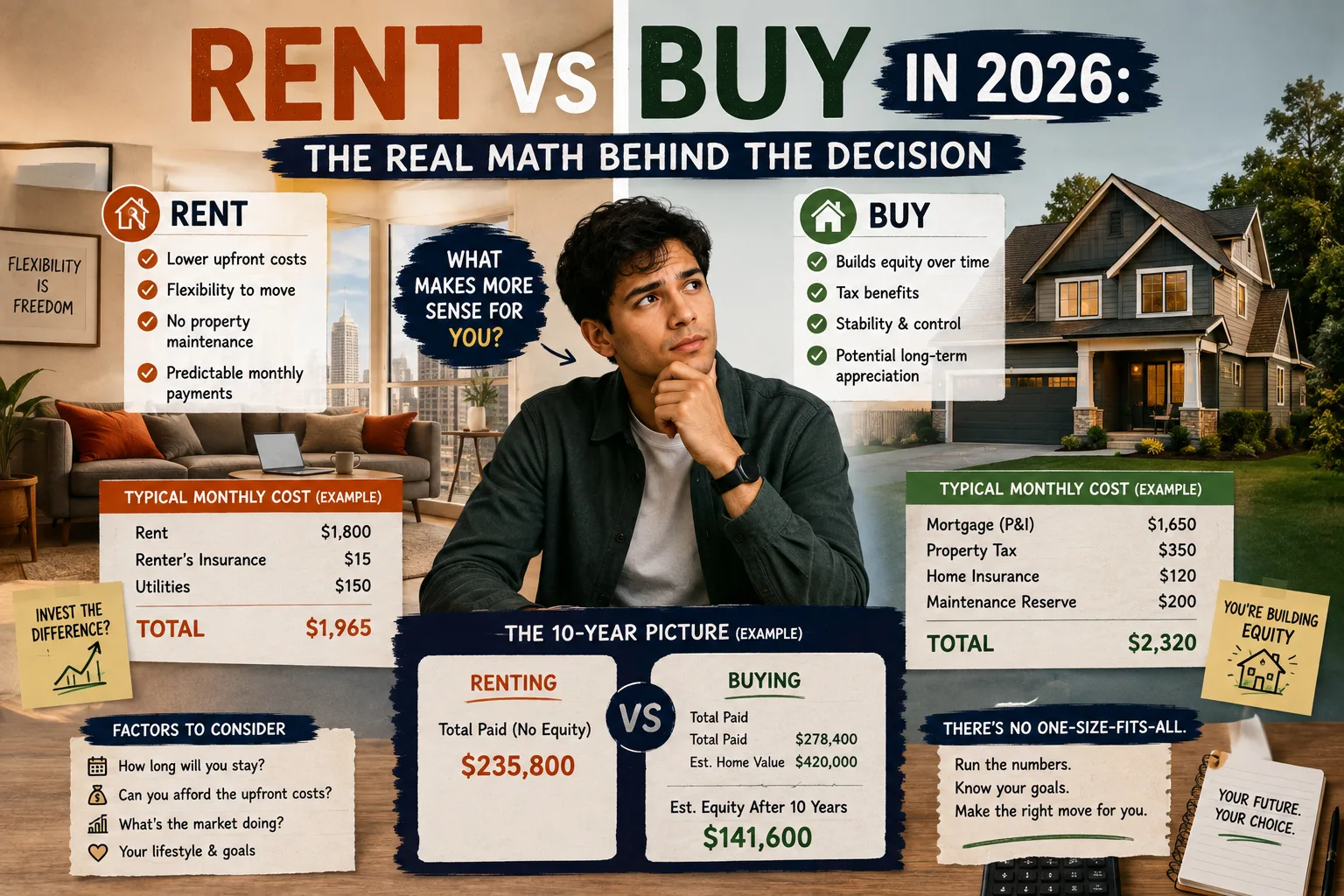
“Renting is throwing money away” is one of the most repeated pieces of financial folk wisdom — and one of the most incomplete. Buying also involves plenty of money that doesn't build wealth: interest, maintenance, taxes and fees among them. Neither renting nor buying is universally better; the honest answer depends on numbers specific to your situation, your local market, and how long you'll actually stay. Here's the framework, not a verdict.
The opportunity cost of a down payment
A down payment is often the single largest number in this decision, and it's also money that stops being available for anything else — including investing it. If a $30,000 down payment could instead have been invested and grown at a reasonable long-run rate, that forgone growth is a real cost of buying, even though it never shows up on a mortgage statement. This is called opportunity cost: the value of the next-best thing you gave up by choosing one option over another. It doesn't mean buying is wrong — it means the down payment isn't “free” just because it becomes home equity instead of cash in a bank.
Owning costs more than the mortgage payment
A mortgage EMI is the visible, budgeted cost of owning — but it's rarely the full cost. Property tax (where applicable), building or homeowner association fees, insurance, and maintenance (a commonly used rule of thumb is budgeting roughly 1% of a property's value per year for upkeep, though this varies a lot by property age and type) all add up to a real, recurring cost on top of the mortgage. Renters typically don't pay any of these directly — they're baked into the rent the landlord charges, but the renter isn't exposed to a surprise roof repair or a sudden special assessment on a shared building. Compare total monthly cost of ownership, not just the mortgage installment, against total rent.
The value of mobility — the case for renting that's easy to underrate
Renting has a real, if less quantifiable, advantage: flexibility. A renter facing a job opportunity in another city, a relationship change, or simply wanting to downsize can typically act within a lease term's notice period. Selling a home involves transaction costs (agent fees, closing costs, and time on market) that commonly run into several percent of the property's value — costs that erode any equity gained if a move happens sooner than expected. Buying tends to make the most financial sense when you're reasonably confident you'll stay put for several years; the shorter your expected time in a property, the more those transaction costs eat into any advantage of owning.
Break-even thinking: the right question to ask
Rather than asking “is renting or buying better” in the abstract, the sharper question is: at what point does buying's advantage overtake its upfront and ongoing extra costs, given how long I'll realistically stay? That crossover point — often called a break-even horizon — depends on local home prices relative to local rents, mortgage rates, expected maintenance, and how long you stay before selling. In markets where prices are high relative to rents, the break-even horizon can stretch out for many years; in markets where rent is expensive relative to prices, it can be much shorter. There's no single global answer — it has to be run on local numbers.
A simple way to frame it for yourself
- Estimate total monthly cost of owning (EMI + estimated maintenance + fees + insurance) and compare it directly against current rent for a comparable property.
- Estimate what the down payment could otherwise earn if invested, over your expected time horizon, using the compound interest calculator.
- Be honest about how long you'll likely stay — the shorter the horizon, the more transaction costs favor renting; the longer, the more building equity favors buying.
- Run the loan side properly with the loan calculator to see exactly how much of early payments go to interest versus principal — it changes how quickly “equity” actually builds.
This is a framework for thinking through the decision, not a recommendation either way — property markets, mortgage rates and rental yields vary enormously by city, so the honest answer only comes from running your own real local numbers.
Frequently asked questions
Is renting always 'throwing money away'?Not really — it's an incomplete framing. Buying also involves costs that don't build wealth (interest, maintenance, fees, transaction costs), and a down payment carries a real opportunity cost since it can't be invested elsewhere while it's tied up in a property.
A commonly used rough guideline is around 1% of the property's value per year, though this varies widely by the property's age, type and local labor costs. It's a starting estimate, not a guarantee — actual maintenance costs are lumpy, not evenly spread.
It's the value of what you give up by choosing one option over another — specifically, the return a down payment could have earned if invested instead of put into a property. It's a real cost even though it never appears on any bill.
There's no universal number, but the general pattern is: the longer you expect to stay, the more buying's upfront and transaction costs get spread out and offset by equity built. Buying for a very short expected stay usually favors renting instead.
No — property tax where applicable, association or maintenance fees, insurance, and repair costs all add to the real monthly cost of ownership, on top of the mortgage installment itself.
Related tools
- EMILoan / EMI Calculator
Work out your monthly instalment, total interest and full amortization schedule.
- CICompound Interest Calculator
See how savings grow with a year-by-year compound growth table.
- SGSavings Goal Calculator
How long to reach a savings target with monthly deposits.
- %Percentage Calculator
Percent of a number, percentage share, and increase or decrease.