 Genzee
How to Make a Professional Invoice for Free
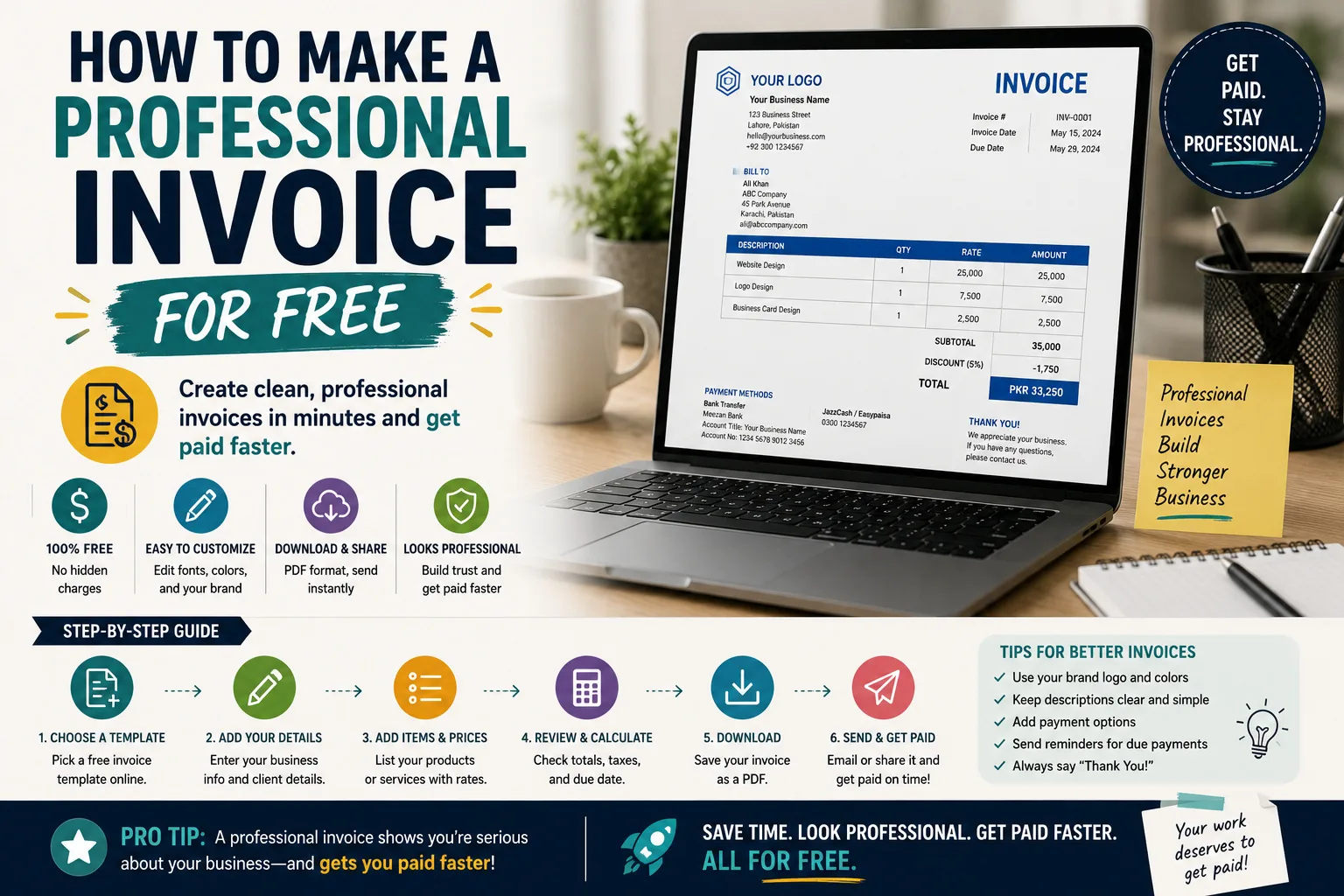
For freelancers and small businesses, the invoice is more than a bill — it is the document that gets you paid on time, keeps your records straight, and quietly signals whether you are a professional or a hobbyist. The good news: you don't need accounting software or a designer to produce a clean one. This guide covers what every invoice must contain, the mistakes that delay payments, and a workflow using our free invoice generator that takes under five minutes per invoice.
The nine things every invoice needs
- The word "Invoice" — obvious, but it distinguishes the document from a quotation or receipt, which matters to clients' accounts departments.
- A unique invoice number — sequential, never reused (INV-001, INV-002 …). It's how both sides reference the bill in every future conversation.
- Invoice date — the date payment terms count from.
- Your details — name or business name, address, phone, email; add your NTN if registered.
- Client details — the legal name that will actually pay. Billing "Ahmed bhai" when the payer is "Falcon Traders (Pvt) Ltd" is a classic payment-delayer.
- Itemised lines — description, quantity, rate and amount for each deliverable. "Services rendered — 50,000" invites questions; three specific lines invite payment.
- Subtotal, tax and total — with the tax rate stated explicitly if you charge one.
- Payment terms — "Due within 14 days" plus your bank account or wallet details. No terms = no urgency.
- A thank-you or notes line — small courtesy, real effect on relationships.
Build it in five minutes
Open the generator, fill your details and the client's, add line items — totals compute live, including tax. Then press Print → Save as PDF: the print stylesheet strips the website away and outputs a clean A4 sheet. Because everything runs in your browser, client names and rates never touch a server — worth knowing when you invoice under an NDA.
A worked example
Sana, a freelance developer in Islamabad, finishes a website for a boutique. Her lines: "Homepage + 4 inner pages — 1 × PKR 60,000", "Contact form integration — 1 × PKR 8,000", "One year hosting setup — 1 × PKR 12,000". Subtotal PKR 80,000; she is not sales-tax registered, so tax stays 0%. Terms: "50% already received; balance PKR 40,000 due within 7 days — Bank Alfalah, account …". Numbered INV-2026-018, saved as PDF, emailed with a one-line message. Paid in three days.
Numbering schemes that scale
Pick one and stick to it: plain sequence (INV-001), year-based (2026-001, resetting each January — easiest at tax time), or client-coded (FT-2026-003 for Falcon Traders). Year-based numbering also tells you at a glance how many invoices your business issued this year, and gaps in the sequence are the first thing any auditor asks about — so never delete a cancelled invoice; issue a credit note or mark it void.
Getting paid on time
- Invoice immediately. Every day between delivery and invoice adds a day to payment.
- Short, explicit terms. "Due within 14 days of invoice date" beats "payment on completion". For new clients, consider 50% advance.
- Make paying easy. Full bank details (title, account/IBAN) on the invoice itself. A QR code with your payment details — made with our QR generator — removes one more excuse.
- Follow up on a schedule, not on mood. A polite reminder the day after the due date, again a week later. Attach the invoice every time so nobody has to search.
- Charge for chronic lateness. A stated late fee (say 2% per month) is less about the money than the signal.
Keep records like it matters — because it does
Store every issued invoice (a simple Invoices-2026 folder of PDFs is fine), reconcile them against bank credits monthly, and total them at year end: that figure is your gross revenue for your tax return — estimate what you'll owe with the tax calculator if you also draw a salary. Six months of consistent, numbered invoices is also the paper trail banks ask for when a freelancer applies for a credit card or loan.
A professional invoice costs nothing but attention. Give it the five minutes it deserves, and it repays you in faster payments and cleaner books — starting with the very next one you send.
Invoice questions freelancers actually ask
Should I charge tax on my invoice? Only if you're registered for the relevant tax. Many freelancers below registration thresholds correctly issue invoices with 0% tax; adding "GST" you never remit is both illegal and a client-side accounting problem. When you do register, show the rate and your registration number on every invoice — the sales tax calculator handles the arithmetic.
Rupees or dollars for foreign clients? Invoice in the agreed contract currency (usually USD for international work) and let the payment route handle conversion — but state your bank's receiving details precisely, and consider noting "charges borne by sender" to avoid surprise deductions eating fixed-price margins.
What if a client disputes an invoice? The itemised lines are your defence: point to the specific line, the agreed scope message, and the delivery. This is why one-line invoices ("services — 50,000") cost real money — disputes against them are unwinnable arguments about memory.
How long should I keep invoices? Six years is the safe records horizon for tax purposes in Pakistan. A single cloud folder per year, PDFs named by number, satisfies both FBR and your own future self chasing a five-month-old payment. Numbering discipline plus the generator's print-to-PDF output makes the whole system cost minutes a month.