 Genzee
How to Actually Price Your Freelance Rate (Not Just Salary ÷ Hours)
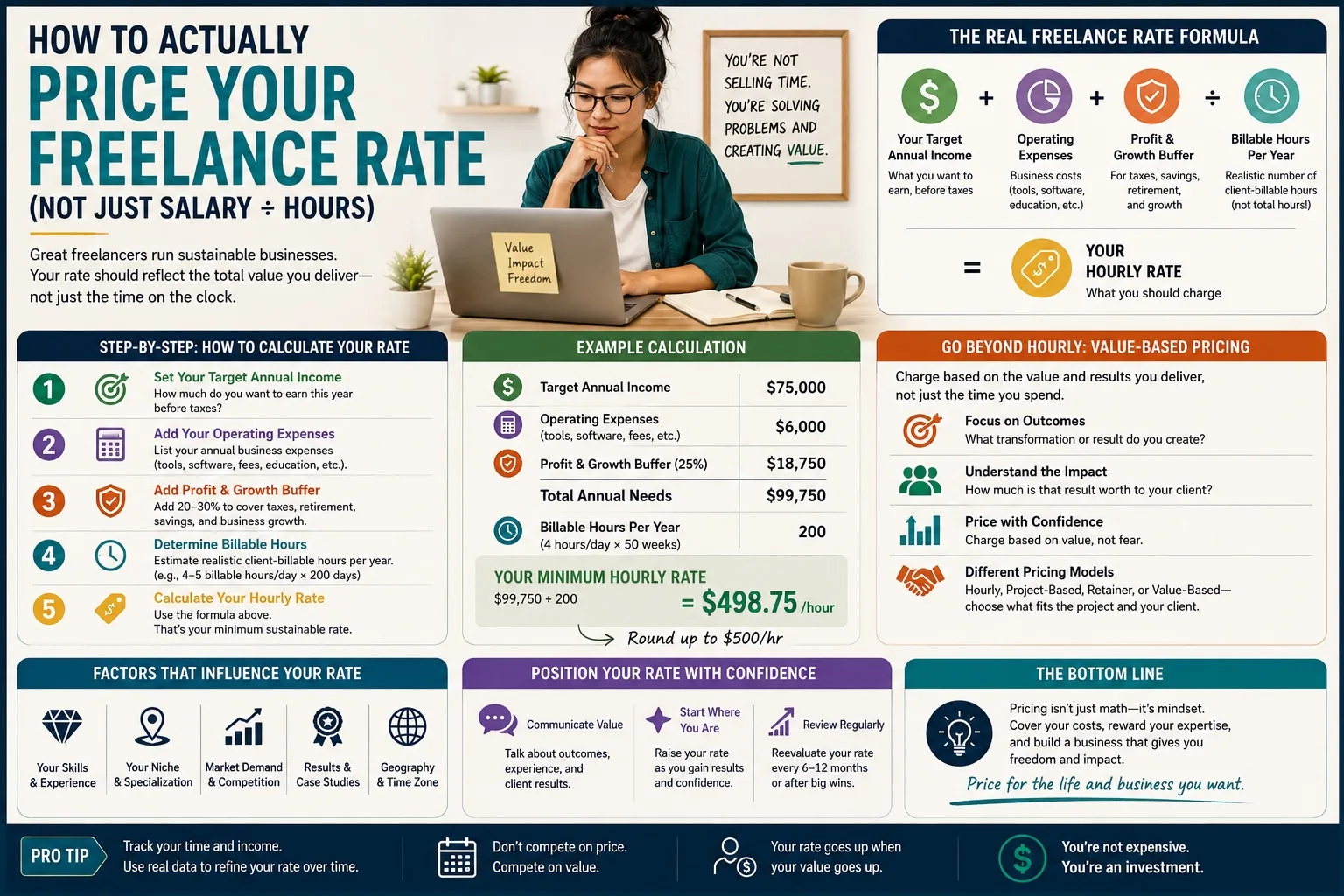
A common way new freelancers set their rate: take a target annual salary, divide by 2,080 (a standard 40-hour work year), and charge that. It feels logical. It is also reliably too low, sometimes by more than half.
Where the simple math breaks down
Salary-divided-by-hours assumes every working hour is billable, that no tax is owed beyond what a salaried employee pays, and that running the business itself costs nothing. None of those assumptions hold for an independent freelancer, and each one pushes the real required rate meaningfully higher than the naive calculation suggests.
Non-billable time is real time
Admin, invoicing, marketing, pitching for new work, and ongoing skill development all take genuine hours but generate no direct revenue. Most freelancers can realistically bill somewhere between 50% and 70% of their total working hours — the rest is the unavoidable overhead of running an independent business, and unlike a salaried job, nobody else is covering that time.
Business expenses and tax both come out of revenue
Software subscriptions, equipment, a share of workspace costs, and other business expenses reduce what a given rate actually nets before tax is even considered. Freelance income is also frequently taxed differently — and often less favorably in terms of withholding — than salaried income, and self-employed individuals typically don't get an employer covering part of their tax burden the way salaried employees implicitly do.
The corrected approach
Start from the number that actually matters: desired take-home pay after tax and expenses. Gross that figure up for business expenses, then gross it up again for tax, and only then divide by realistic billable hours — not total working hours. On a 2,400,000 target income with 15% expenses and 20% tax, spread across 1,200 realistic billable hours a year, the rate that actually delivers the target works out meaningfully higher than a naive salary-divided-by-hours calculation would suggest — often the gap that explains why many new freelancers feel constantly busy but still underpaid.
Revisiting the rate as the business changes
A rate calculated once at the start of a freelance career should not stay fixed indefinitely. As billable-hour ratios improve with better systems and fewer wasted admin hours, or as expenses and tax obligations shift, the underlying numbers feeding the calculation change too — recalculating annually, or whenever a major cost changes, keeps the rate aligned with reality rather than anchored to assumptions made years earlier.
Rate versus what the market will actually pay
This calculation produces the rate needed to hit a specific income target — it does not guarantee clients will pay it. If the calculated rate sits well above what comparable freelancers in a given market or niche charge, the more sustainable fix is usually addressing the inputs (working more efficiently to raise the billable-hour ratio, targeting higher-value clients, specializing) rather than accepting a rate that structurally cannot deliver the intended income no matter how much work comes in.