 Genzee
How to Find Your Business's Break-Even Point (And Why It Matters)
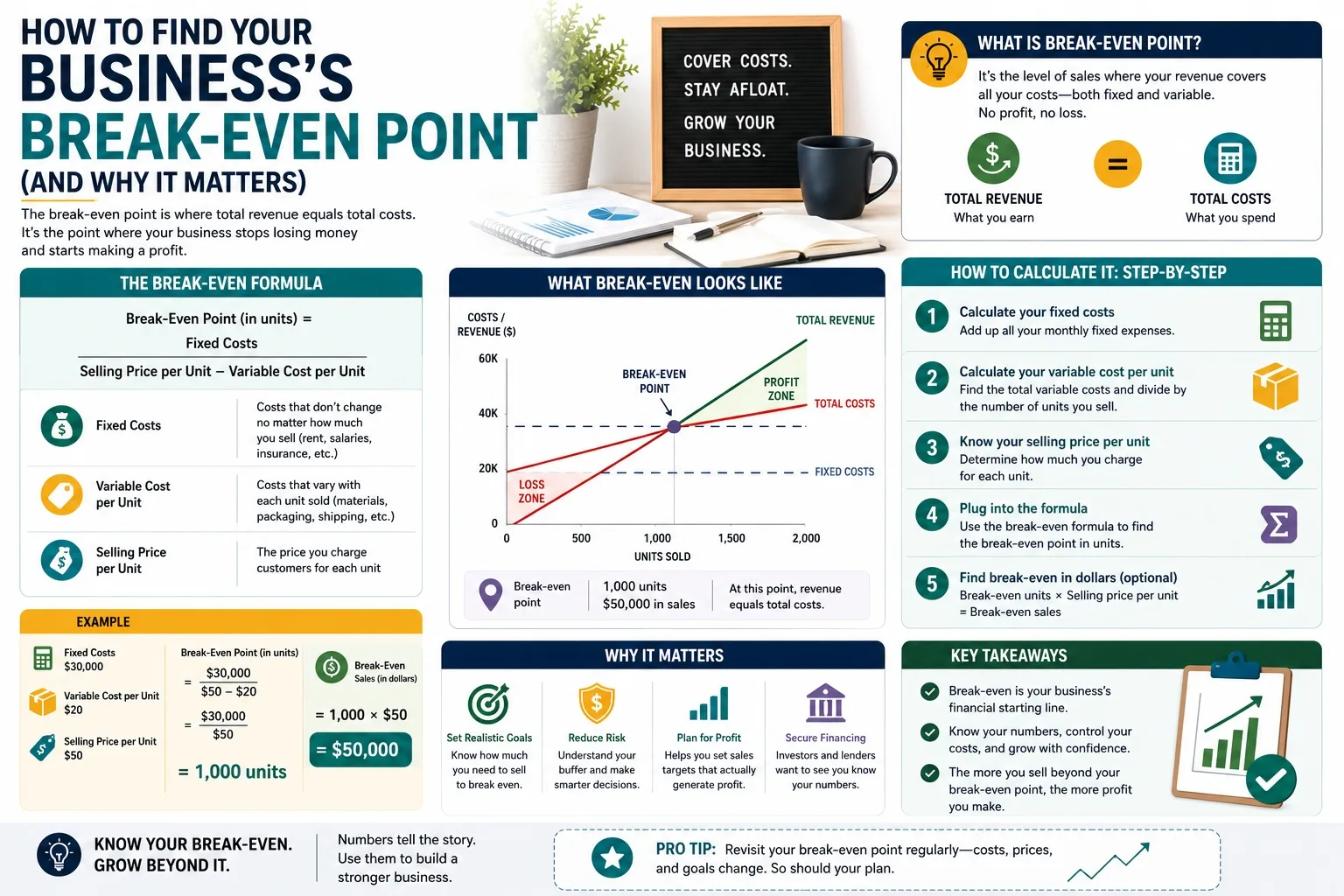
Before a business plan gets to the exciting question of profit, there's a more foundational one worth answering first: at what sales volume does the business stop losing money? That number is the break-even point, and it's one of the most useful early filters for evaluating whether an idea is realistic.
The two types of costs behind the calculation
Fixed costs stay constant regardless of sales volume — rent, salaries, insurance, loan payments. Variable costs scale directly with each unit produced or sold — raw materials, packaging, per-unit shipping. Break-even analysis depends on cleanly separating the two, since it's built entirely around how they behave differently as volume changes.
Contribution margin: the number that does the work
Subtract variable cost per unit from the selling price per unit, and the result is the contribution margin — how much each individual sale contributes toward covering fixed costs before any profit begins. Break-even point, in units, is simply fixed costs divided by contribution margin: the number of sales needed for accumulated contributions to exactly offset the fixed costs.
A worked example
With 500,000 in fixed costs, a selling price of 1,200 and a variable cost of 700 per unit, the contribution margin is 500 per unit. Dividing 500,000 by 500 gives a break-even point of 1,000 units — meaning the 1,001st unit sold in the period is the first one that actually contributes to profit, with every unit before it going toward covering fixed costs.
Why this changes how price changes should be evaluated
A price cut aimed at boosting competitiveness looks appealing on its own, but it directly shrinks the contribution margin per unit — which raises the break-even point, sometimes substantially. A seemingly modest price reduction can require a meaningfully higher sales volume just to reach the same break-even position as before, a trade-off that's easy to overlook without running the actual numbers.
Using break-even analysis beyond a single product
The same logic extends to bigger decisions: opening a new location, hiring an additional employee, or investing in new equipment all add fixed costs that raise the break-even point for the business as a whole. Running a break-even calculation before committing to a major fixed cost is a quick sanity check on whether the expected additional sales volume is actually realistic before signing any contracts.
What break-even analysis does not tell you
Reaching the break-even point confirms costs are covered, but it says nothing about whether the required sales volume is realistic given actual market demand, competition, or capacity constraints. A break-even point of 1,000 units a month is only meaningful alongside a genuine estimate of whether 1,000 units a month can actually be sold — treating the calculation as a full business case on its own, rather than one input into a larger judgment, is a common and avoidable mistake.