 Genzee
How Loan Amortization Actually Works (And Why Early Extra Payments Matter More)
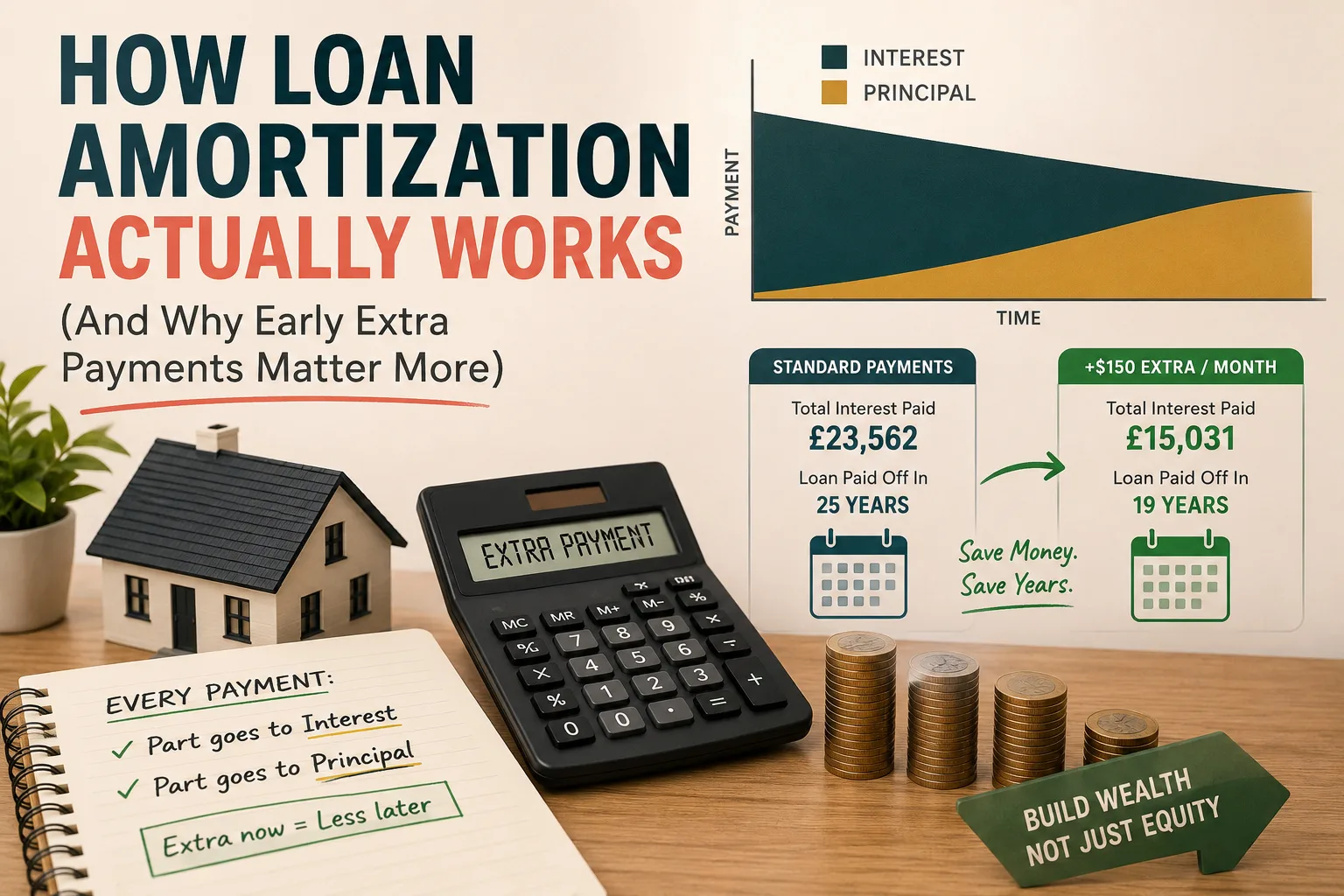
A loan payment looks like one fixed number every month, but underneath it is doing two different jobs at once: covering that period's interest, and reducing the actual balance owed. How much goes to each changes dramatically over the life of the loan — and understanding that shift changes how you should think about extra payments.
Why the split isn't fixed
Interest is calculated on the remaining balance, not on the original loan amount. Early in a loan, when the balance is at its highest, interest eats a larger share of each payment, leaving less to reduce the principal. As payments continue and the balance shrinks, less interest accrues each period, so a growing share of the same fixed payment goes toward principal instead.
A concrete example
On a 3,000,000 loan at 12% over 5 years, the monthly payment works out to roughly 66,700. In month one, a large chunk of that payment is interest on the full 3,000,000 balance — only a modest slice actually reduces the principal. By the final year, the balance is much smaller, so almost the entire payment goes toward principal, with only a small interest charge left. The total payment never changes; only its internal split does.
Why this makes early extra payments more powerful
An extra payment made in month one immediately reduces the balance that every future month's interest is calculated against — for the entire remaining life of the loan. The same extra amount paid in the final year has almost no remaining interest left to save, since the balance is already nearly paid off. This is the mathematical reason financial advice consistently favors extra payments as early as possible over waiting.
What this means practically
If you have any flexibility in when to make extra payments on a loan, front-loading them — even a modest amount in the first year or two — captures more total interest savings than spreading the same extra money evenly across the loan's full term. Checking an amortization schedule for your specific loan makes this concrete instead of theoretical, showing exactly how much interest a given extra payment would save based on when it's made.
Refinancing resets the clock
Refinancing a loan partway through its term restarts amortization from the beginning of a new schedule — even though the outstanding balance may be similar to where the original loan currently sits. This is why refinancing purely to chase a slightly lower rate late in a loan's life can sometimes cost more in total interest than staying the course, once the reset to an early, interest-heavy amortization curve is factored in. Comparing total interest remaining on the current loan against total interest on the proposed new one, not just the interest rate, is the only reliable way to judge whether a refinance is actually worth it.
Fixed-rate versus adjustable-rate amortization
Everything above assumes a fixed interest rate for the life of the loan. Adjustable-rate loans complicate the picture because the amortization schedule itself changes whenever the rate resets — a rate increase part-way through can mean a larger share of upcoming payments reverts to interest for a period, even after years of steady principal progress. Anyone comparing a fixed-rate and adjustable-rate loan side by side should model amortization under both a stable-rate and a rising-rate scenario, not just today's rate.