 Genzee
Gen Z and the Side Hustle Boom: Why 58% Have a Second Income
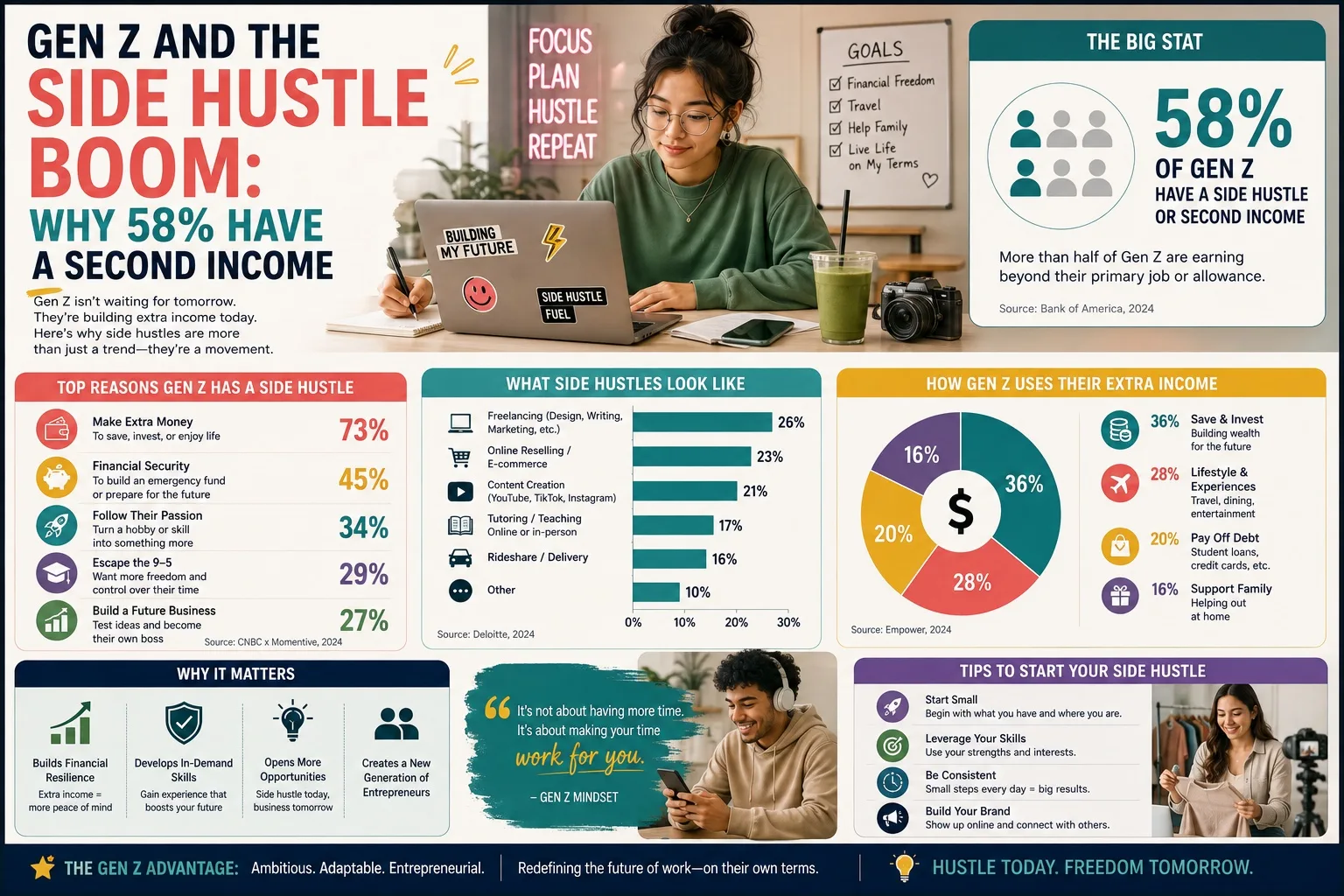
Having one job used to be the default. For Gen Z, it increasingly isn't: 58% report having some form of side hustle, more than double the rate among Baby Boomers. This isn't a story about hustle-culture ambition alone — it's mostly about arithmetic.
Why "income stacking" became normal
Surveys consistently find the same top reason people give for a side hustle: keeping up with inflation and the rising cost of living, cited by over half of respondents, ahead of building savings, paying off debt, or pursuing a passion project. When one income doesn't comfortably cover rent, groceries and the rest, adding a second, smaller income stream is often a faster fix than waiting for a raise.
The gig economy and remote-friendly freelance platforms lowered the barrier to entry considerably compared to a generation ago — tutoring, freelance design, content creation, delivery driving and reselling are all a phone and a few hours away, without the overhead of starting a traditional small business.
What a stacked income does to your budgeting
Two things change when you have more than one income source. First, your total monthly income becomes less predictable — a freelance gig might pay well one month and nothing the next, unlike a fixed salary. Second, tax treatment usually differs: side income is frequently not withheld at source the way a salary is, so an unplanned tax bill is a common surprise for first-time side hustlers.
The practical fix for both is the same: budget against your lowest realistic month, not your average or best month, and set aside a fixed percentage of every side-hustle payment for tax before you spend any of it — treat it as already gone, not as extra spending money.
The other side of the number
It's worth being honest about the trade-off too. Gen Z is also the generation most likely to describe itself as exhausted by the pressure to constantly earn more, and a side hustle taken on purely out of necessity is a different experience from one chosen for passion or flexibility. A second income stream is a tool for closing a gap between income and cost of living — it isn't, by itself, a fix for costs that are structurally too high relative to income.
The motivations, ranked
When people are asked why they picked up a side hustle, the order is fairly consistent across surveys: keeping up with rising costs comes first, followed by building savings, paying off debt, pursuing something they actually enjoy, and — for a smaller group — transitioning toward full-time self-employment. Notice that "getting rich" barely features. Most side hustles are closing a specific, near-term gap rather than chasing a long-shot business idea.
What to check before you commit to one
A few questions are worth answering honestly before taking on a side hustle, not after: how many hours a week can you sustain without it eating into sleep, your main job's performance, or your health? Does the platform or client pay reliably and on a predictable schedule? And critically — have you checked whether the income is taxable, and at what rate, in your specific situation? Side income surprising someone with an unplanned tax bill months later is one of the most common and avoidable side-hustle mistakes.
Making the numbers work together
The cleanest way to manage a stacked income is to keep it in a genuinely separate account from your main salary, and to treat that account as "gross," not "spendable" — move the tax-reserve percentage out first, then treat only the remainder as real income. This one habit avoids the two most common side-hustle problems: spending money that was actually owed to the tax authority, and losing track of whether the hustle is genuinely profitable once time and any expenses are properly accounted for.