 Genzee
The Fairest Way to Split a Group Bill When Everyone Paid Different Amounts
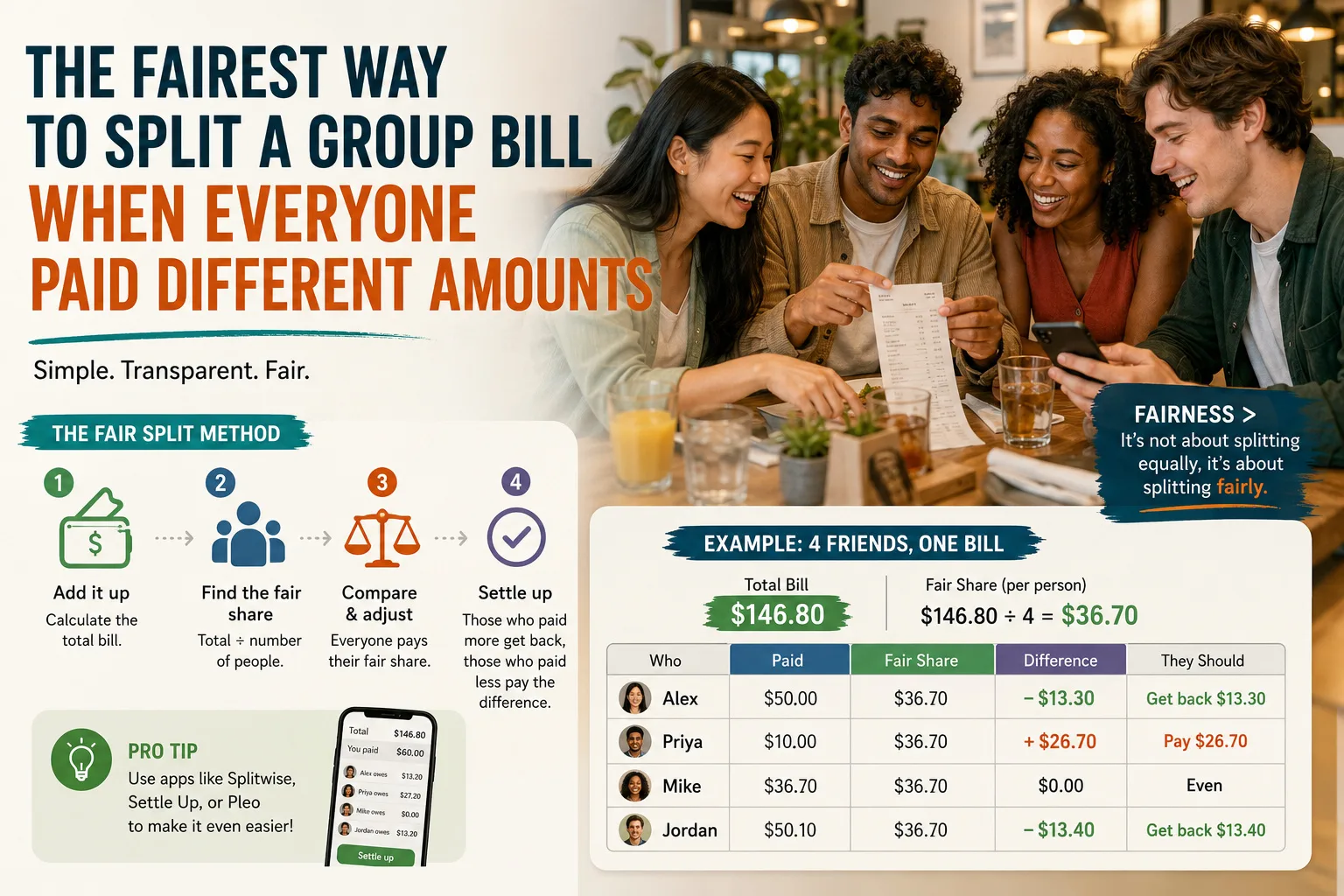
Splitting a single bill evenly is trivial — divide by the number of people. It gets genuinely more complicated the moment a group trip or event involves several payments made by several different people at different times, and everyone just wants to know, at the end, who actually owes whom.
Why "just Venmo each other back" gets messy
Without a structured approach, a group of five people who each covered something during a trip can end up trying to untangle a web of who paid for what, often resulting in far more individual payments back and forth than actually necessary — some people overpaying their true share, others underpaying, without a clear final picture.
The actual fair-split calculation
Add up everything spent by the whole group, divide by the number of people, and that's everyone's fair share. Compare what each person actually paid against that fair share: anyone who paid more than their share is owed money; anyone who paid less owes money. This turns a confusing pile of receipts into a clear, simple picture of who's in credit and who's in debit.
Minimizing the number of actual payments
Once everyone's balance is known, the group doesn't need every debtor to pay every creditor individually — matching the largest debtor against the largest creditor, settling what can be settled, then moving to the next pair, produces the fair outcome using far fewer total transactions than a naive pairwise settlement would require. For most group sizes, this reduces settlement to just a handful of payments rather than a dozen or more.
Where this matters beyond one dinner
The same logic applies to shared trips, group gifts, roommate expenses, or any situation where costs get covered unevenly by different people over time — anywhere money changes hands informally within a group benefits from the same clean, fair-share approach rather than an ad hoc attempt to remember who owes what.
Keeping it simple in practice
The math itself takes seconds once every payment is recorded — the real friction is usually just remembering to track who paid what as it happens, rather than trying to reconstruct it from memory or scattered receipts at the end. A quick note after each payment, however informal, makes the eventual settlement calculation immediate rather than a forensic exercise.
When an equal split isn't actually fair
An equal-share split assumes everyone consumed roughly the same amount, which doesn't always hold — one person's flight was more expensive, another skipped a meal entirely. In those cases, adjusting each person's recorded contribution to reflect what they should genuinely owe, before running the fair-share calculation, keeps the settlement accurate rather than technically "equal" but not actually fair to everyone involved.
Settling up sooner rather than later
The longer a group waits to settle after a shared trip or event, the harder it becomes to remember exactly who paid for what, and the more likely small amounts get written off as "not worth chasing" even when they'd add up to something real if left unresolved. Running the settlement calculation shortly after the last expense, while receipts and memory are both fresh, produces a more accurate result with far less friction than trying to reconstruct it weeks later.