 Genzee
The Credit Card Minimum Payment Trap: Why It Takes So Long, With Real Numbers
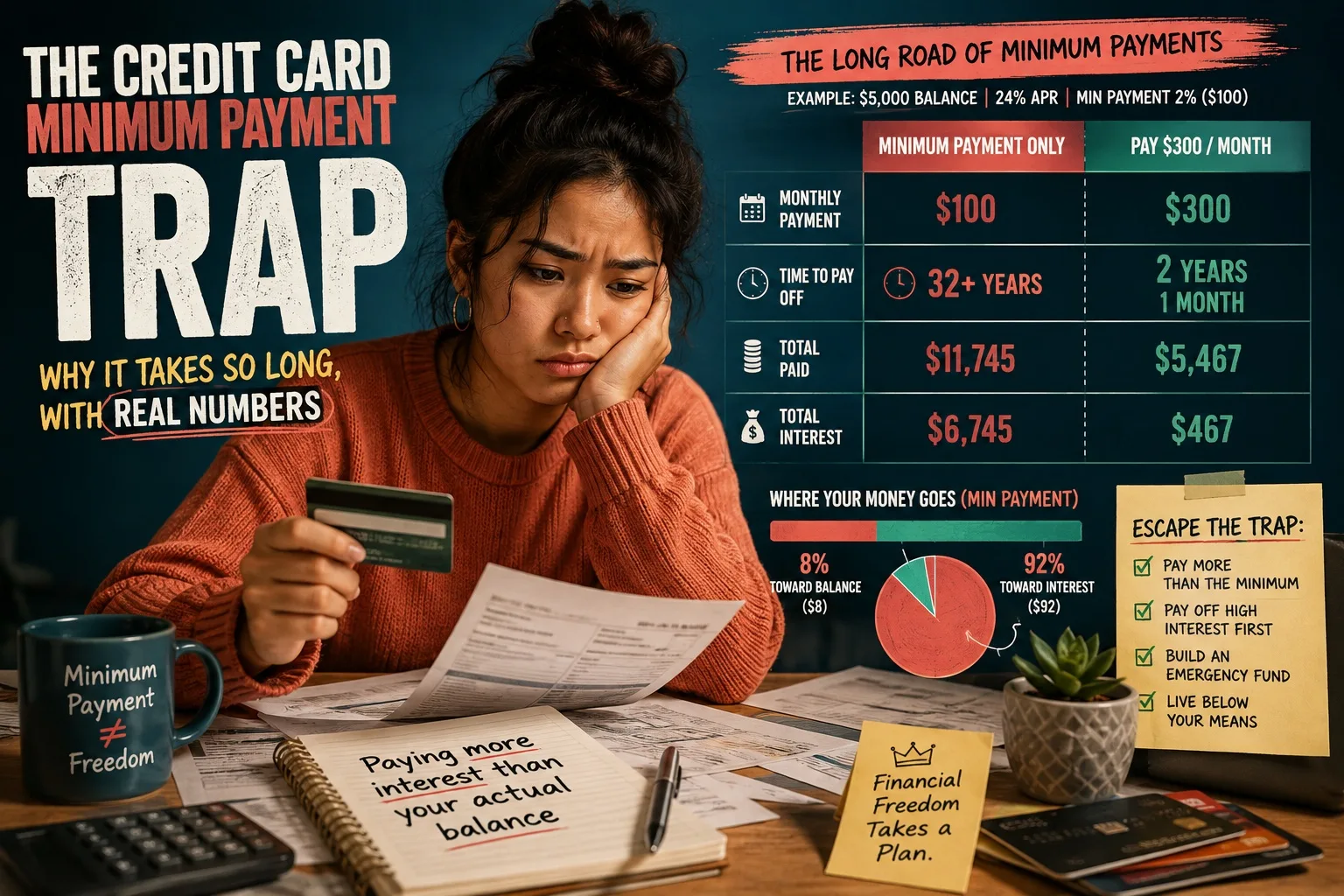
A credit card minimum payment is designed to feel manageable — small enough that almost anyone can make it. That's exactly what makes it dangerous: a payment engineered to be easy is also, by the same design, engineered to shrink the balance as slowly as the issuer can get away with.
How the minimum is actually calculated
Most issuers calculate the minimum as a percentage of the current balance — commonly 3-5% — or a flat floor amount, whichever is higher. Because it's a percentage of a moving target, the required payment falls every single month right alongside the balance, unlike a fixed loan installment that stays constant until fully paid off.
A concrete example
Take a 150,000 balance at 30% APR, with a 5% minimum payment (floor 2,000). Paying only that shrinking minimum every month takes roughly six years and nine months to clear — and along the way, total interest paid comes to over 126,000, close to the size of the original balance itself. The card effectively costs the borrower nearly double the amount originally charged, purely through the mechanics of minimum-only payments.
Why the trap is so easy to fall into
Nothing about a minimum-only payment feels irresponsible in any given month — the bill gets paid, no late fees, no default. The cost is invisible in the short term and only becomes obvious when totalled over years, which is precisely why it doesn't feel urgent to fix in the moment it's happening.
What actually breaks the pattern
A fixed payment — any amount that doesn't shrink as the balance does — breaks the cycle immediately, because it captures an increasing share of principal every month instead of a shrinking one. Even a modest, consistent overpayment above the calculated minimum can cut years off the payoff timeline and save a meaningful share of the total interest, without requiring the payment to be dramatically larger.
Where to start if you are in this position
The most direct fix is simple in principle even if not always easy in practice: pick a fixed payment amount above the current minimum and stick to it every month regardless of how the calculated minimum moves. Running your own balance and rate through a payoff calculator, comparing minimum-only against a chosen fixed payment, turns an abstract "pay more than the minimum" piece of advice into a concrete number worth committing to.
Why balance transfers are not automatically a fix
Moving a balance to a new card with a promotional low or 0% rate can genuinely help, but only if the payoff behavior changes alongside it — transferring a balance and then continuing to pay only the new card's minimum simply relocates the same slow-payoff pattern to a different account, often with a transfer fee added on top. A balance transfer works best paired with a fixed, above-minimum payment plan from the start, not as a standalone solution.